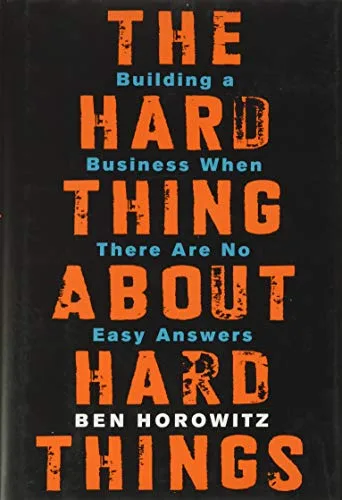
The Hard Thing About Hard Things
Building a Business When There Are No Easy Answers
by Ben Horowitz
- Published
- 2014
- Pages
- 304 pages
- Publisher
- Harper Business
- Readers
- 4 members have read this
Ben Horowitz's account of keeping Loudcloud alive through the dot-com crash, selling its services arm to EDS and rebuilding it as Opsware, which HP bought for $1.6 billion in 2007. It's a manual for the parts of running a company that MBA courses skip: layoffs, firing executives, wartime leadership and deciding whether to sell.
Most management books describe how to build a great company once things are going well. Horowitz writes about the months when they are not. He co-founded Loudcloud with Marc Andreessen in 1999, saw it come close to bankruptcy after the dot-com bust, remade it into the software company Opsware and sold that to Hewlett-Packard for $1.6 billion in 2007. He went on to co-found the venture firm Andreessen Horowitz.
The first third of the book tells that story. The rest is practical advice, much of it adapted from essays on Horowitz's blog, on how to lay people off, how to demote a friend, how to hire executives for jobs you have never done, and the difference between a peacetime CEO and a wartime CEO. Chapters open with rap lyrics.
Reviewers had reservations. Publishers Weekly found the military metaphors overdone and some advice borrowed. Ira Stoll noted that several sections ran nearly verbatim on the blog years earlier, and that HP stock did poorly after the deal, which complicates the idea of a sale as a triumph. The language is profane throughout.
For investors, bankers and anyone who backs or advises founders, it is the clearest first-hand account of what a CEO faces when cash is running out, and a good lens for judging management teams under stress.
- Tell it like it is. Horowitz argues that a CEO who hides bad news loses the trust of the staff; employees can help solve problems they know about.
- Lay people off quickly and in person. Once the decision is made, delays leak out and managers should deliver the news to their own people; how a company handles layoffs shapes the culture that survives them.
- Wartime and peacetime need different CEOs. A company facing an existential threat needs a leader who narrows focus and breaks rules, and investors should ask which mode a business is in before judging its management.
- Management debt compounds. Short-term fixes such as counteroffers to keep a star or putting two people in one job create costs that come due later, much as financial leverage does.
- There are no silver bullets, only lead bullets. When a competitor has a better product, the answer is usually to do the hard engineering work rather than hunt for a clever deal or marketing fix.
The book moves from memoir to field manual, following the order in which a CEO meets these problems.
- From Netscape to Loudcloud. Horowitz describes growing up in Berkeley as the son of a New Left editor, his years at Netscape, and founding Loudcloud with Marc Andreessen in 1999, then taking it public because private investors would no longer fund it.
- Survival and the pivot. He recounts the near-death of the business, the layoffs, the 2002 sale of the services operation to EDS, and the rebuilding of Opsware into a software company that HP bought in 2007.
- When things fall apart. A run of chapters on what he calls the Struggle: telling employees the truth, laying people off the right way, firing and demoting executives, and why there is no single silver bullet in a crisis.
- People, products, profits. Advice on training staff, hiring executives from big companies, avoiding management debt, minimizing politics, setting titles and promotions, and programming a company's culture.
- Leading without a map. The psychology of the job, including the fine line between fear and courage, peacetime versus wartime CEOs, how to become a CEO and how boards should evaluate one.
- No rules. Closing chapters on balancing accountability with creativity, whether to sell a company, and his move into venture capital at Andreessen Horowitz.
Reader reviews
No reviews yet. Join to write the first one.