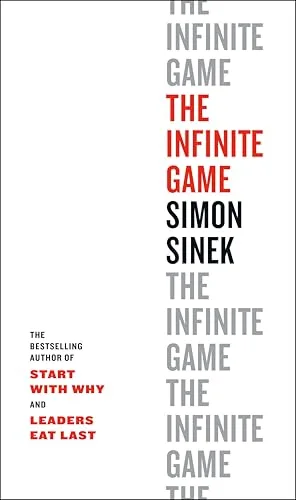
The Infinite Game
by Simon Sinek
- Published
- 2019
- Pages
- 272 pages
- Publisher
- Portfolio
- Readers
- 1 member has read this
Simon Sinek borrows James Carse's distinction between finite games, played to win, and infinite games, played to keep playing, and argues that companies run for quarterly wins wear themselves out. It is a leadership book rather than a finance book, but its attack on shareholder primacy and short-term incentives speaks directly to how markets reward management.
Sinek's premise is that business has no finish line. Players come and go, the rules shift and nobody is ever declared the winner, so leaders who manage for rankings, quarterly targets or beating a named rival are playing the wrong game. Against that he sets out five practices of an infinite mindset: advance a just cause, build trusting teams, study worthy rivals, prepare for existential flexibility and demonstrate the courage to lead.
Sinek is a former advertising executive turned speaker and author, best known for Start with Why and Leaders Eat Last. The book draws its frame from Carse's 1986 Finite and Infinite Games and fills it with corporate examples, from Microsoft and Walmart to Wells Fargo and Kodak.
The book is accessible and was a bestseller, but careful readers have objections. A review in The Strategy Bridge argued that Sinek misreads Carse, who saw only one infinite game and did not treat finite play as bad, and that he turns the idea back into a way to beat competitors. The same review found the case studies oversimplified, and noted that some of what Sinek treats as causes of failure could just as well be its effects.
Finance readers will get most from the material on Milton Friedman's shareholder doctrine and executive pay, which frame the long-term versus short-term debate that runs through governance and stewardship investing.
- There is no quarter that wins the game. Business has no end point, so metrics such as quarterly earnings or market share should be read as progress markers, not as the goal.
- Will and resources both deplete. A company stays in the game only while it has money and the morale of its people. Managing purely for financial results can drain the second until the first follows.
- Watch for ethical fading. Wells Fargo's fake accounts show how aggressive targets and small rationalizations can turn into systemic misconduct, which is a governance risk investors should look for.
- Shareholder primacy is a choice, not a law of nature. Sinek argues that Friedman's doctrine reshaped incentives and executive pay in ways that reward short-term moves over durable value.
- Disrupt yourself first. Existential flexibility means changing the business model before a rival forces it, as Kodak declined to do with digital photography.
The book moves from a definition of the two kinds of games, to a critique of how modern business keeps score, to a practical toolkit.
- Finite and infinite games. Sinek lays out Carse's distinction, argues that business, politics and life are infinite games, and explains why companies exit when they lose the will or resources to keep playing. The Vietnam War serves as an example of a side that won battles but was outlasted.
- The cost of finite thinking. He traces shareholder primacy to Milton Friedman's 1970 essay and links it to soaring executive pay, citing CEO pay that rose from about 30 times the average worker's in 1978 to 271 times by 2016. Microsoft under Ballmer is the cautionary case.
- Just cause. A just cause is a specific vision of a future that does not yet exist, one that is for something, inclusive, service-oriented, resilient and idealistic, and it gives people a reason to sacrifice.
- Trusting teams and ethical fading. Using Shell and US military training, he argues that trust matters more than individual performance, and shows through Wells Fargo how performance pressure lets small rationalized breaches compound.
- Worthy rivals, existential flexibility and courage. He urges leaders to learn from rivals instead of obsessing over beating them, to be willing to upend a business model for the cause, as Kodak failed to do, and to make costly choices such as dropping tobacco sales.
NEW YORK TIMES BESTSELLER The New York Times-bestselling author of Start With Why, Leaders Eat Last, and Together Is Better offers a bold new approach to business strategy by asking one question: are you playing the finite game or the infinite game? In The Infinite Game, Sinek applies game theory to explore how great businesses achieve long-lasting success. He finds that building long-term value and healthy, enduring growth - that playing the infinite game - is the only thing that matters to your business.
Reader reviews
No reviews yet. Join to write the first one.