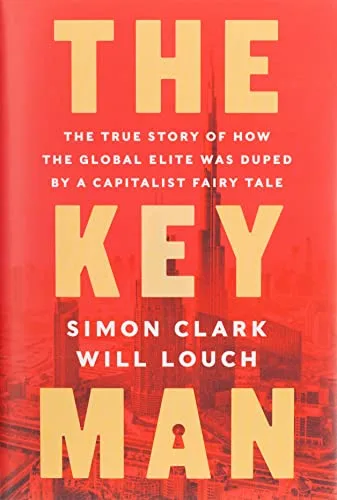
The Key Man
The True Story of How the Global Elite Was Duped by a Capitalist Fairy Tale
by Simon Clark and Will Louch
- Published
- 2021
- Pages
- 368 pages
- Publisher
- Harper Business
- Readers
- 3 members have read this
Two Wall Street Journal reporters reconstruct the rise and collapse of Abraaj Group, the Dubai private equity firm whose founder, Arif Naqvi, raised money from the Gates Foundation, the World Bank's IFC and Western governments by promising profits and poverty relief at once. It is a case study in how an impact story can disarm due diligence.
Abraaj Group, founded by Arif Naqvi in Dubai in 2002, became the best-known private equity firm in emerging markets, managing close to $14 billion at its peak. It sold Western investors on a simple pitch: buy businesses in Pakistan, Africa and the Middle East, earn strong returns and do good along the way. The book argues that behind the pitch, Naqvi and senior colleagues were inflating valuations and moving investor cash around to cover a hole in the firm's finances and fund his lifestyle.
Simon Clark and Will Louch broke much of the story at the Journal after a whistleblower contacted them in 2018. For the book they interviewed more than 150 people, including about 70 former Abraaj employees.
Reviewers praised the reporting and the account of business culture in Pakistan and the Gulf. In the Literary Review, Ian Fraser noted that the authors attack Abraaj's governance without naming who sat on its board over 17 years, and he found the habit of calling people by first names awkward. The book also blames professional advisers, including KPMG, for helping hide the firm's real condition.
Read it alongside Bad Blood and the Wirecard books. It is most useful for anyone who allocates to private funds or sells impact strategies.
- Check where the cash sits. Abraaj's problems surfaced when an investor asked a basic question: where is our committed capital right now? Reconciling cash against fund documents is the cheapest due diligence there is.
- Mission can lower the guard. Investors who would have pushed a buyout shop hard gave a firm that promised to fight poverty the benefit of the doubt. A social goal is no substitute for controls.
- Watch the sprawl of entities. A structure of hundreds of offshore companies made it easy to move money between funds and hard for anyone to see the whole picture.
- Key-man risk cuts both ways. Funds that lean on one founder's network for deals and fundraising also depend on that founder's honesty, and boards rarely check him.
- Auditors and advisers are not a safety net. The authors argue that firms earning large fees from Abraaj helped polish its image. A clean audit and blue-chip partners did not mean the books were sound.
The book is told as a chronological narrative, from Naqvi's ambitions in Karachi to his arrest in London.
- Origins. Naqvi, born in Karachi in 1960, starts at Arthur Andersen in London and moves into Gulf dealmaking. The authors trace the hunger for status, power and control that would later shape the firm.
- Building Abraaj. He founds the firm in Dubai in 2002, buys Aureos Capital in 2012, and markets frontier economies as places of opportunity. The firm takes on projects like the rescue of Karachi Electric, the city's struggling power utility.
- The impact pitch. Naqvi becomes a fixture at Davos and a favorite of development lenders, the Gates Foundation and politicians. Money pours in for a $1 billion health care fund and other vehicles.
- The hidden hole. The authors describe a web of more than 300 companies, mostly in tax havens, and a firm short of cash for salaries and rent. Investor money is used to plug gaps and keep up appearances.
- Unraveling. Gates Foundation staff ask where the health fund's money is. Whistleblower emails and Journal stories follow, and Abraaj collapses into liquidation in 2018.
- Aftermath. Naqvi is arrested in London in 2019 and charged in the US with fraud and racketeering, then fights extradition.
In this compelling story of lies, greed and tarnished idealism, two Wall Street Journal reporters investigate a man who Bill Gates, Western governments, and other investors entrusted with billions of dollars to make profits and end poverty, but who now stands accused of masterminding one of the biggest, most brazen financial frauds ever. Arif Naqvi was charismatic, inspiring, and self-made—all the qualities of a successful business leader. The founder of Abraaj, a Dubai-based private-equity firm, Naqvi was the Key Man to the global elite searching for impact investments to make money and do good. He persuaded politicians he could help stabilize the Middle East after 9/11 by providing jobs and guided executives to opportunities in cities they struggled to find on the map. Bill Gates helped him start a $1 billion fund to improve healthcare in poor countries and the UN and Interpol appointed him to boards. As Pope Francis blessed a move to harness capitalism for the good of the poor, Naqvi won the support of Obama’s administration and investors, who compared him to Tom Cruise in Mission: Impossible. In 2018, Simon Clark and Will Louch were contacted by an anonymous whistleblower who said Naqvi had swindled investors out of hundreds of millions of dollars and offered bribes to sustain his billionaire lifestyle. Digging into the claims, Clark and Louch uncovered hundreds of documents and exposed the wrongdoing. In April 2019—months after their exposé broke—Naqvi was arrested on charges of fraud and racketeering, and faces up to 291 years in jail. Populated by a cast of larger-than-life characters and moving across Asia, Africa, Europe and America, The Key Man is the story of how the global elite was duped by a capitalist fairytale. Clark and Louch shine a light on efforts to clean up global capital flows even as opaque private equity firms amass trillions of dollars and offshore tax havens cast a veil of secrecy which prevents regulators, investors and citizens from understanding what’s really going on in the finance industry.
Reader reviews
No reviews yet. Join to write the first one.