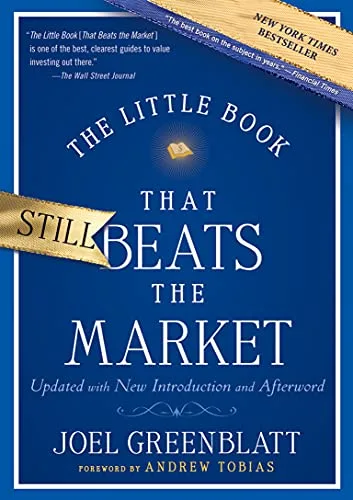
The Little Book That Still Beats the Market
- Published
- 2010
- Pages
- 208 pages
- Publisher
- Wiley
- Readers
- 4 members have read this
Joel Greenblatt's short, plain-English case for buying good businesses at bargain prices, reduced to a ranking of companies by return on capital and earnings yield that he calls the magic formula. The 2010 edition updates the 2005 bestseller with results through the financial crisis, and remains the clearest introduction to systematic value investing.
Greenblatt wrote the original Little Book That Beats the Market (2005) so that his children could understand what he does for a living. He explains what any business is worth, why Mr. Market so often offers companies at prices far from their value, and why buying with a margin of safety works. He then turns two ideas, a high return on capital and a high earnings yield, into a mechanical screen anyone can follow.
The author is a practitioner. Greenblatt founded Gotham Capital in 1985 and earned roughly 50 percent a year from 1985 to 1994 after expenses but before the general partner's incentive fee, taught value investing at Columbia Business School for two decades, and wrote You Can Be a Stock Market Genius. The 2010 edition adds the formula's performance through 2009.
Its most useful idea is behavioral: the formula works over time precisely because it can lag the market for a year or more, which most investors cannot tolerate. Independent backtests have generally found that the approach beats the market over long periods, but by less than the original edition reported, and with more volatility and long stretches of underperformance. Some of the excess return also maps onto well-known value and quality factors.
Read it before more technical books on quantitative value, or as a short course in valuation for interns and new analysts.
- Value comes from future earnings. A business is worth what it will earn over time, discounted for time and risk, which is the lesson of the gum example.
- Buy good companies cheaply. Ranking on return on capital and earnings yield together avoids both cheap junk and great companies at any price.
- Mr. Market is emotional. Prices swing far more than business values, which creates the bargains the formula looks for.
- Expect to lag. A sound strategy can underperform for one to three years; staying with it is the hard part and the source of the edge.
- Be systematic. Following a simple rule, holding a diversified basket and rebalancing yearly keeps emotion out of decisions.
The book is a sequence of short, untitled chapters followed by step-by-step instructions, the 2010 afterword and an appendix.
- Valuing a business. Greenblatt starts with Jason, a sixth-grader who resells gum at school, and uses the question of what half of Jason's business is worth to introduce earnings, the time value of money and uncertainty.
- Mr. Market and bargains. He explains Benjamin Graham's idea that the market's mood swings throw up prices far above and below value, and why investors need a margin of safety.
- Good and cheap. He defines the two measures at the heart of the formula, return on capital, to find good businesses, and earnings yield, to find cheap ones, and shows how ranking companies on both identifies bargains.
- Why it keeps working. Greenblatt shows that the formula can trail the market for long stretches, and argues that this discomfort is why it is not arbitraged away.
- Putting it to work. The step-by-step section explains how to use a screen to buy 20 to 30 top-ranked stocks over time and rebalance once a year, and the afterword reviews results through the 2008 crisis.
In 2005, Joel Greenblatt published a book that is already considered one of the classics of finance literature. In The Little Book that Beats the Market—a New York Times bestseller with 300,000 copies in print—Greenblatt explained how investors can outperform the popular market averages by simply and systematically applying a formula that seeks out good businesses when they are available at bargain prices. Now, with a new Introduction and Afterword for 2010, The Little Book that Still Beats the Market updates and expands upon the research findings from the original book. Included are data and analysis covering the recent financial crisis and model performance through the end of 2009. In a straightforward and accessible style, the book explores the basic principles of successful stock market investing and then reveals the author’s time-tested formula that makes buying above average companies at below average prices automatic. Though the formula has been extensively tested and is a breakthrough in the academic and professional world, Greenblatt explains it using 6th grade math, plain language and humor. He shows how to use his method to beat both the market and professional managers by a wide margin. You’ll also learn why success eludes almost all individual and professional investors, and why the formula will continue to work even after everyone knows” it. While the formula may be simple, understanding why the formula works is the true key to success for investors. The book will take readers on a step-by-step journey so that they can learn the principles of value investing in a way that will provide them with a long term strategy that they can understand and stick with through both good and bad periods for the stock market. As the Wall Street Journal stated about the original edition, Mr. Greenblatt...says his goal was to provide advice that, while sophisticated, could be understood and followed by his five children, ages 6 to 15. They are in luck. His ‘Little Book’ is one of the best, clearest guides to value investing out there.”
Reader reviews
No reviews yet. Join to write the first one.