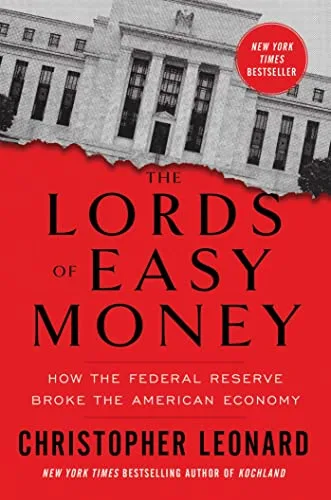
The Lords of Easy Money
How the Federal Reserve Broke the American Economy
- Published
- 2022
- Pages
- 368 pages
- Publisher
- Simon & Schuster
- Readers
- 2 members have read this
The Kochland author tells the story of the Fed's post-2008 zero-rate and quantitative-easing era through Thomas Hoenig, the Kansas City Fed president who dissented in 2010. Leonard argues that years of easy money inflated asset prices, fed leveraged lending and widened inequality. Investors get a sharply argued, contested account of the policy regime that shaped a decade of markets.
Christopher Leonard's argument is that the Federal Reserve's response to the 2008 crisis, near-zero rates and trillions of dollars of bond buying kept going for years, did more for asset owners than for workers. It pushed investors into riskier assets, swelled leveraged loans, kept indebted zombie companies alive, and left a financial system that needed rescuing again in 2020.
Leonard is a business journalist, the author of Kochland and The Meat Racket, not an economist. His guide is Thomas Hoenig, a career central banker who ran the Kansas City Fed and voted against Ben Bernanke's second round of quantitative easing in 2010.
The reporting on how FOMC decisions get made won praise. Publishers Weekly called it timely and persuasive, and Kirkus singled out the material on zombie companies. Economists pushed back hard. Adam Tooze, reviewing it for the New York Times, found the populist framing grating and the idea that Hoenig's path would have avoided later excess implausible. Thomas Hogan at Econlib said Leonard blames monetary policy for inequality and offshoring on thin evidence and makes factual errors.
Read it as a well-reported brief for one side of the QE debate, alongside Nick Timiraos's Trillion Dollar Triage for the other.
- Policy rates are an asset-price story. When the Fed holds rates at zero and buys bonds, investors are pushed into riskier assets. Higher prices for stocks, credit and property follow, whatever happens to wages.
- Watch leverage where yields are chased. Leonard ties the growth of leveraged loans, CLOs and zombie companies to a decade of cheap money. Those are the places credit analysts look first when rates rise.
- The Fed put changes behavior. Repeated rescues, from Continental Illinois to 2020, teach markets to expect support. That expectation is itself a source of risk-taking.
- Dissent on the FOMC is rare and costly. Hoenig's 2010 votes show how much consensus shapes Fed policy, and why the minutes are worth reading for who disagrees.
- Read the critics too. Economists dispute Leonard's claims about inequality and bubbles and argue that the cost of doing less in 2010 was high. Weighing both sides is the point.
The book is told as a narrative of meetings and personalities, built around Hoenig's career.
- The dissent. Leonard opens in 2010, as Hoenig casts lonely votes against Bernanke's plan for a second round of quantitative easing.
- Hoenig's education. The story goes back to the 1970s, when easy credit in Kansas City farm and energy lending turned into a collateral spiral, then to the Penn Square collapse and the Continental Illinois bailout that shaped Hoenig's fear of cheap money.
- The QE decade. After 2008 the Fed cuts rates to zero and expands its balance sheet through repeated asset purchases. Leonard follows how excess bank reserves, the search for yield, leveraged loans and CLOs grew, and how asset prices rose faster than wages.
- Powell's Fed. Jerome Powell, a lawyer who made his money in private finance before joining the Fed, becomes chair. The Fed tries to tighten and then retreats.
- The pandemic rescue. In 2020 the Fed intervenes on a far larger scale, backstopping markets including corporate debt. Leonard argues that this confirmed a system in which each rescue requires a bigger one.
The New York Times bestselling business journalist Christopher Leonard infiltrates one of America's most mysterious institutions--the Federal Reserve--to show how its policies over the past ten years have accelerated income inequality and put our country's economic stability at risk--
Reader reviews
No reviews yet. Join to write the first one.