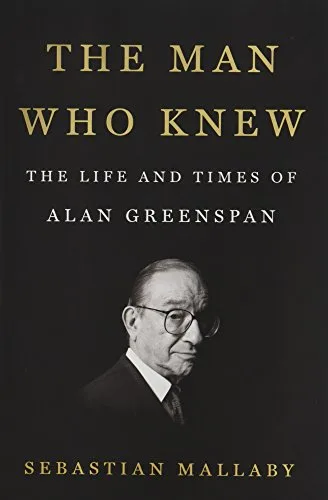
The Man Who Knew
The Life and Times of Alan Greenspan
- Published
- 2016
- Pages
- 800 pages
- Publisher
- Penguin Press
- Readers
- 2 members have read this
Sebastian Mallaby's biography of Alan Greenspan, which won the 2016 FT and McKinsey Business Book of the Year, argues that the Fed chairman was neither a naive ideologue nor an infallible maestro. Greenspan understood the dangers of leverage and asset bubbles better than almost anyone and still did not act. It is the essential account of how modern central banking and modern finance grew up together.
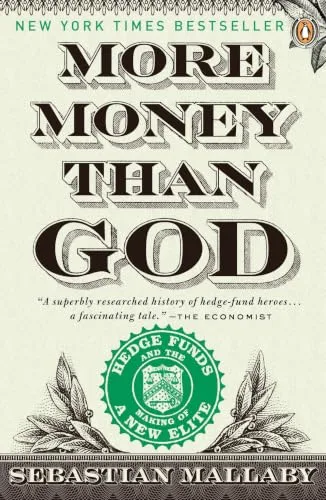
Mallaby, a former Economist and Washington Post journalist and now a senior fellow at the Council on Foreign Relations, spent five years researching this life of Greenspan, which runs from a modest childhood through 18 years at the Federal Reserve. He had extensive access to Greenspan and the people closest to him, and used documents obtained through Freedom of Information requests. His earlier book, More Money Than God, a history of hedge funds, won a Gerald Loeb Award. Running through the life is a larger story: the shift from the regulated postwar financial system to the deregulated, derivatives-heavy markets of the 2000s.
The central argument cuts against both caricatures. Greenspan had shed his youthful libertarian absolutism, pushed for tighter oversight in some areas without success, and worried openly about irrational exuberance. His failure, Mallaby argues, was one of action. He focused on inflation, deferred to political limits and would not lean against bubbles.
Reviewers in the FT, WSJ, Economist and Washington Post praised its reporting and balance, and Kirkus added that the crisis had roots older than Greenspan's tenure. The book runs to about 800 pages, and Mallaby's view that the Fed should have used policy to restrain asset prices remains contested among central bankers.
It is a core text for macro investors, rates traders and anyone who wants to understand how the Fed actually makes decisions.
- Inflation control is not financial stability. Greenspan kept consumer prices tame while leverage and asset prices built up, so price stability alone is not proof of safety.
- Knowing is not acting. Greenspan saw the risks in mortgages, derivatives and exuberant markets but chose not to fight them. The binding constraint was political and institutional, not intellectual.
- Central banking is the art of the possible. Congress, presidents and markets limited what the Fed could do. Reading Fed policy means reading its politics.
- Data obsession can be an edge. Greenspan's habit of mining obscure industrial and productivity data let him make his 1996 call that the economy could grow faster without inflation. Bottom-up evidence can overturn consensus models.
- Rescues create expectations. The 1987 response, the LTCM rescue and repeated rate cuts taught markets to expect a Fed backstop. Investors should price that moral hazard, and the risk that it fails.
The book is a chronological biography that widens into a history of American economic policy from the 1950s to the 2008 crash.
- Formation. Greenspan grows up in Washington Heights, plays saxophone and clarinet in a swing band, studies economics at NYU, and builds the consulting firm Townsend-Greenspan by crunching industrial data for corporate clients.
- Rand and politics. He joins Ayn Rand's circle and writes libertarian essays, then moves into Republican politics through Nixon's 1968 campaign and chairs the Council of Economic Advisers under Ford during the stagflation of the mid-1970s.
- Washington insider. Out of office, he leads the 1983 Social Security commission and cultivates the networks that bring him to the Fed in 1987, just before the October stock market crash.
- The maestro years. Mallaby covers the 1994 tightening, the 1996 productivity call that let growth run, the irrational exuberance warning, the rescue of Long-Term Capital Management, and his fights over derivatives regulation.
- Bubbles and the reckoning. The dot-com bust, low rates after 2001, the housing boom and the growth of shadow banking lead to his 2006 retirement amid acclaim. The 2008 crisis then wrecks his reputation, and Mallaby closes with his judgment on why the man who knew did not act.
Exceptional . . . Deeply researched and elegantly written . . . As a description of the politics and pressures under which modern independent central banking has to operate, the book is incomparable.” —Financial Times The definitive biography of the most important economic statesman of our time Sebastian Mallaby's magisterial biography of Alan Greenspan, the product of over five years of research based on untrammeled access to his subject and his closest professional and personal intimates, brings into vivid focus the mysterious point where the government and the economy meet. To understand Greenspan's story is to see the economic and political landscape of our time—and the presidency from Reagan to George W. Bush—in a whole new light. As the most influential economic statesman of his age, Greenspan spent a lifetime grappling with a momentous shift: the transformation of finance from the fixed and regulated system of the post-war era to the free-for-all of the past quarter century. The story of Greenspan is also the story of the making of modern finance, for good and for ill. Greenspan's life is a quintessential American success story: raised by a single mother in the Jewish émigré community of Washington Heights, he was a math prodigy who found a niche as a stats-crunching consultant. A master at explaining the economic weather to captains of industry, he translated that skill into advising Richard Nixon in his 1968 campaign. This led to a perch on the White House Council of Economic Advisers, and then to a dazzling array of business and government roles, from which the path to the Fed was relatively clear. A fire-breathing libertarian and disciple of Ayn Rand in his youth who once called the Fed's creation a historic mistake, Mallaby shows how Greenspan reinvented himself as a pragmatist once in power. In his analysis, and in his core mission of keeping inflation in check, he was a maestro indeed, and hailed as such. At his retirement in 2006, he was lauded as the age's necessary man, the veritable God in the machine, the global economy's avatar. His memoirs sold for record sums to publishers around the world. But then came 2008. Mallaby's story lands with both feet on the great crash which did so much to damage Alan Greenspan's reputation. Mallaby argues that the conventional wisdom is off base: Greenspan wasn't a naïve ideologue who believed greater regulation was unnecessary. He had pressed for greater regulation of some key areas of finance over the years, and had gotten nowhere. To argue that he didn't know the risks in irrational markets is to miss the point. He knew more than almost anyone; the question is why he didn't act, and whether anyone else could or would have. A close reading of Greenspan's life provides fascinating answers to these questions, answers whose lessons we would do well to heed. Because perhaps Mallaby's greatest lesson is that economic statesmanship, like political statesmanship, is the art of the possible. The Man Who Knew is a searching reckoning with what exactly comprised the art, and the possible, in the career of Alan Greenspan.
Reader reviews
No reviews yet. Join to write the first one.