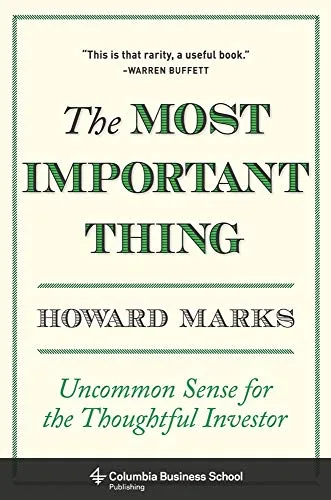
The Most Important Thing
Uncommon Sense for the Thoughtful Investor
by Howard Marks
- Published
- 2011
- Pages
- 200 pages
- Publisher
- Columbia Business School Publishing
- Readers
- 4 members have read this
Oaktree Capital co-founder Howard Marks distills decades of client memos into 20 short chapters on how to think about value, risk, cycles and investor psychology. Warren Buffett called it that rarity, a useful book. For anyone who manages money, it is the clearest modern statement of how a disciplined contrarian investor thinks about risk.
Howard Marks built his reputation on memos. As chairman and co-founder of Oaktree Capital Management, the Los Angeles firm known for distressed debt and credit investing, he has written to clients for decades, and the memos became required reading on Wall Street. Warren Buffett has said they are the first thing he opens in his mail. This book reorganizes their ideas into a single philosophy, part memoir and part creed.
Each of the 20 chapters begins with the phrase the most important thing is, followed by a different idea, from second-level thinking and the relationship between price and value to cycles, contrarianism and defensive investing. The point is that successful investing requires attention to all of them at once.
His treatment of risk is the book's core: risk is the chance of permanent loss, not volatility, and it is highest when investors feel safest. Kirkus called it a clear and expert resource, and Martin Fridson in Barron's praised its insights into the psychology behind investors' habitual errors. The ideas are not new; they extend Graham and Buffett. What Marks adds is a practitioner's vocabulary for cycles and risk.
In 2013 Columbia published The Most Important Thing Illuminated, which adds annotations by Christopher Davis, Joel Greenblatt, Paul Johnson and Seth Klarman, a new chapter on reasonable expectations and a foreword by Bruce Greenwald. Either version belongs on every investor's desk.
- Use second-level thinking. Asking whether a company is good is not enough. Ask what the consensus expects, what is priced in and why you might be right when others are wrong.
- Risk is permanent loss. Volatility is not the same as risk. The real risk is losing money for good, and it is greatest when investors feel safest and prices are highest.
- The price you pay matters most. Any asset can be a good or bad investment depending on price. Buying below intrinsic value is the most reliable source of returns.
- Know where we stand in the cycle. You cannot predict the future, but you can judge whether investors are greedy or fearful now and adjust how aggressive you are.
- Win by not losing. Avoiding big losers matters more than catching big winners. Defensive investing gives up some upside to survive bad years and compound over time.
After an introduction explaining how the memos became a book, Marks works through 20 short chapters that build from how to think, to how to measure risk, to how to act.
- Thinking differently. Second-level thinking asks not just whether a company is good but what is already priced in. Markets are efficient enough that beating them requires an edge, but they are not perfectly efficient.
- Value and price. Marks defines value investing as buying for less than intrinsic value and argues that the price paid is the main determinant of returns. A good asset bought at too high a price is a bad investment.
- Risk. Three chapters on understanding, recognizing and controlling risk make the case that risk means the probability of loss, that it rises when people think it has disappeared, and that controlling it is the mark of a superior investor.
- Cycles and psychology. Chapters on cycles, the pendulum of sentiment and negative influences such as greed, fear and envy explain why markets swing too far in both directions.
- Acting on it. Contrarianism, finding bargains, patient opportunism, knowing what you don't know and sensing where we stand in the cycle turn the ideas into practice.
- Defense. The closing chapters on luck, defensive investing, avoiding pitfalls and adding value end with a summary of how the pieces fit together.
Reader reviews
No reviews yet. Join to write the first one.