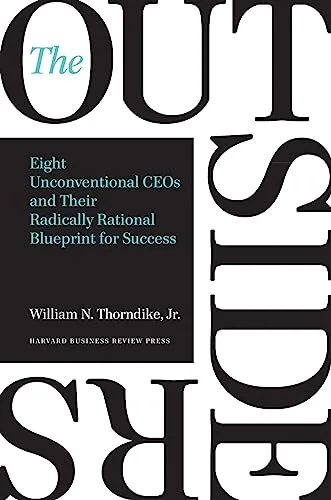
The Outsiders
Eight Unconventional CEOs and Their Radically Rational Blueprint for Success
- Published
- 2012
- Pages
- 251 pages
- Publisher
- Harvard Business Review Press
- Readers
- 2 members have read this
Profiles of eight CEOs, among them Henry Singleton, Tom Murphy, John Malone, Katharine Graham and Warren Buffett, whose shareholder returns far outstripped the market because they treated capital allocation as their main job. Investor William Thorndike shows how buybacks, disciplined acquisitions, decentralization and indifference to Wall Street's opinion compounded value over decades.
Most business books celebrate charismatic leaders who build empires. William Thorndike's subject is a quieter group of chief executives whose companies, by his measure, beat the S&P 500 by a wide margin over long tenures. What they shared was an approach to capital: they thought about every dollar of cash flow as an investment choice among reinvestment, acquisitions, debt repayment, dividends and buybacks, ran lean and decentralized headquarters, and largely ignored analysts and the press.
Thorndike is a private equity investor who founded Housatonic Partners, and he wrote the book from an investor's chair, comparing each CEO's record with the market and with peers. Buffett recommended it in his 2012 shareholder letter as an outstanding book on CEOs who excelled at capital allocation, singling out the chapter on Tom Murphy.
The book has become a standard text among value investors and owner-operators, and it reads quickly. The obvious caveat is selection: the eight were chosen because they succeeded, so the book cannot show how often the same tactics, such as heavy buybacks or leverage, went wrong elsewhere, and the chapters are admiring rather than critical. Pair it with Buffett's shareholder letters for the underlying philosophy. Anyone who analyzes management teams, sits on a board or runs a business should read it.
- Capital allocation is the CEO's main job. Over a long tenure, how a chief executive deploys cash flow matters more to shareholders than operational flair or growth for its own sake.
- Buy back stock when it is cheap. Several of the eight, Singleton above all, shrank their share counts dramatically when prices were low, concentrating value for remaining owners.
- Per-share value beats size. The outsiders measured success by value per share, not revenue or empire, which led them to sell, shrink or stand still when that paid better.
- Decentralize operations, centralize capital decisions. Small headquarters and autonomous managers kept costs down while the CEO kept tight control of where money went.
- Ignore the consensus when the math says so. The eight often did what Wall Street disliked, from avoiding dividends to taking on debt, because their own numbers showed a better return.
After a preface on Henry Singleton and an introduction that defines the outsider approach, the book gives one chapter to each CEO, then draws the common threads together.
- Tom Murphy and Capital Cities. A media company built through careful acquisitions, lean operations and decentralization, culminating in the purchase of ABC.
- Henry Singleton and Teledyne. A conglomerate builder who issued stock when it was expensive and later bought most of it back when it was cheap.
- Bill Anders and General Dynamics. A defense-industry turnaround in which Anders sold businesses, shrank the company and returned capital to shareholders.
- John Malone and TCI. Cable television built with leverage, tax-minimizing structures and a focus on cash flow rather than reported earnings.
- Stiritz, Smith and Graham. Bill Stiritz runs Ralston Purina like a public LBO, Dick Smith diversifies the family-controlled General Cinema, and Katharine Graham takes the helm at the Washington Post Company and later buys back stock heavily.
- Buffett and the outsider mindset. A chapter on Buffett as investor-CEO is followed by a synthesis of what the eight shared and an epilogue with an example and a checklist for applying the approach.
It's time to redefine the CEO success story. Meet eight iconoclastic leaders who helmed firms where returns on average outperformed the S&P 500 by more than 20 times.
Reader reviews
No reviews yet. Join to write the first one.