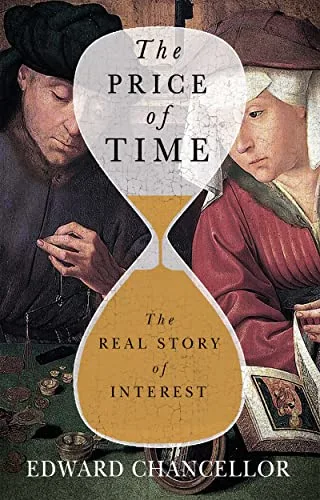
The Price of Time
The Real Story of Interest
- Published
- 2022
- Pages
- 432 pages
- Publisher
- Atlantic Monthly Press
- Readers
- 3 members have read this
A financial historian's case that interest is the price that coordinates capitalism, and that a decade of near-zero rates after 2008 fed bubbles, zombie companies, weak productivity and inequality. Read it for the long history of credit, from Mesopotamia to quantitative easing, and for a sharp critique of modern central banking.
Edward Chancellor treats interest as the price of time: the charge that lets savers, borrowers and investors value cash flows that arrive in the future. The first third of the book is a history of that idea; the rest is an indictment of the era after the 2008 crisis, when central banks held rates at the lowest levels in recorded history. Chancellor argues that money priced too cheaply caused malinvestment, inflated asset prices, financialization through buybacks and leveraged deals, and the survival of zombie firms that should have failed.
Chancellor writes as an investor as much as a historian. He worked in M&A at Lazard Brothers, spent 2008 to 2014 on GMO's asset allocation team, and wrote Devil Take the Hindmost, a standard history of speculation. His intellectual heroes here are Knut Wicksell and the BIS economists William White and Claudio Borio, who warned that easy money breeds credit booms.
The book won the 2023 Hayek Book Prize and was longlisted for the FT Business Book of the Year. Reviewers praised the history but split on the thesis. The Economist admired the survey of interest and classical economics but called the argument seriously flawed, pressing the question of what rates were artificially low compared with. Eric Rauchway in the TLS found the diagnosis sharp and the remedies thin.
Read it if you allocate capital, price duration risk or want a serious, well-sourced version of the Austrian-leaning critique of the Fed.
- Interest is a price, not a policy lever. Chancellor argues that suppressing the cost of money distorts every valuation that depends on discounting, from equities to real estate.
- Cheap money has costs that show up slowly. Malinvestment, asset inflation, financialization and zombie firms build quietly and can surface years after rates were cut.
- Low rates widen inequality. Asset owners with collateral borrow cheaply and gain from rising prices, while savers and pension funds earn less on safe assets.
- Price stability is not enough. Chancellor sides with the BIS economists Claudio Borio and William White, who warned that central banks focused on consumer-price inflation were ignoring credit growth and asset bubbles.
- History repeats in the credit cycle. From the nineteenth-century manias to the 2010s, periods of artificially easy credit tend to end in speculation and a painful reckoning, so long stretches of low volatility deserve suspicion.
The book moves from a long history of interest to an indictment of the post-2008 era, then to a political warning. Chancellor sets the stage with the nineteenth-century French quarrel between the anarchist Pierre-Joseph Proudhon, who called interest theft, and Frédéric Bastiat, who defended it.
- Interest before money. Lending at interest is older than coinage: loans of silver and barley in the third and second millennia BCE, Hammurabi's rules and the long religious hostility to usury, which gave way from the late Middle Ages as interest came to be accepted as the lender's due.
- Arguments over cheap money. Josiah Child pushes for lower rates and John Locke objects, Bagehot chronicles the manias that easy credit fed, and Knut Wicksell's idea of a natural rate frames the danger of holding market rates below it, a story carried into the 1920s.
- The age of zero rates. After 2008 central banks push rates to record lows. Chancellor rejects secular stagnation as the explanation and draws on the BIS economists' warnings to describe the four horsemen of cheap money: malinvestment, bloated asset prices, financialization and zombie companies.
- Who pays. Savers and pension funds chase returns into riskier assets, and inequality widens as asset owners gain.
- A new road to serfdom. He closes by warning that ever-cheaper money draws the state deeper into deciding where capital goes.
The first book of the next crisis. Longlisted for the 2022 Financial Times Business Book of the Year Award All economic and financial activities take place across time. Interest coordinates these activities. The story of capitalism is thus the story of interest: the price that individuals, companies and nations pay to borrow money. In The Price of Time, Edward Chancellor traces the history of interest from its origins in ancient Mesopotamia, through debates about usury in Restoration Britain and John Law ' s ill-fated Mississippi scheme, to the global credit booms of the twenty-first century. We generally assume that high interest rates are harmful, but Chancellor argues that, whenever money is too easy, financial markets become unstable. He takes the story to the present day, when interest rates have sunk lower than at any time in the five millennia since they were first recorded - including the extraordinary appearance of negative rates in Europe and Japan - and highlights how this has contributed to profound economic insecurity and financial fragility. Chancellor reveals how extremely low interest rates not only create asset price inflation but are also largely responsible for weak economic growth, rising inequality, zombie companies, elevated debt levels and the pensions crises that have afflicted the West in recent years - conditions under which economies cannot possibly thrive. At the same time, easy money in China has inflated an epic real estate bubble, accompanied by the greatest credit and investment boom in history. As the global financial system edges closer to yet another crisis, Chancellor shows that only by understanding interest can we hope to face the challenges ahead.
Reader reviews
No reviews yet. Join to write the first one.