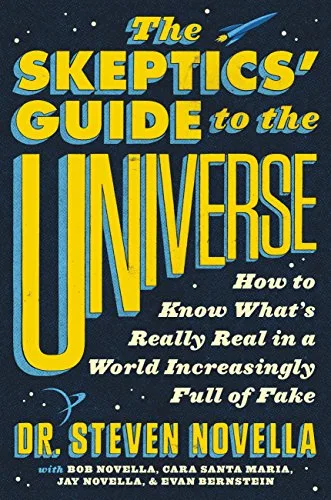
The Skeptics' Guide to the Universe
How to Know What's Really Real in a World Increasingly Full of Fake
by Steven Novella, Bob Novella, Cara Santa Maria, Jay Novella and Evan Bernstein
- Published
- 2018
- Pages
- 512 pages
- Publisher
- Grand Central Publishing
- Readers
- 2 members have read this
Yale neurologist Steven Novella and his podcast co-hosts turn years of debunking into a handbook on how memory, perception and reasoning fail, and how to tell science from pseudoscience. Not a finance book, but its chapters on biases, fallacies, free-energy scams and bad science reporting are a sound toolkit for vetting any claim, including an investment pitch.
The book grew out of The Skeptics' Guide to the Universe, the science podcast Novella has hosted with his brothers Bob and Jay, Evan Bernstein and, later, Cara Santa Maria. Novella, a clinical neurologist at Yale School of Medicine, is the lead author. Its stated aim is to inoculate readers against bad science, deception and faulty thinking.
Roughly half the book covers the machinery of error: how perception and memory mislead us, the cognitive biases and logical fallacies that distort reasoning, and how science itself goes wrong through p-hacking, failed replication and denialism. The rest applies those tools to cautionary tales and to science reporting.
Kirkus said the book succeeds superbly, and Publishers Weekly praised its plain prose and its advice on talking with closed-minded friends and relatives by finding common ground rather than picking a fight. At about 500 pages, it works better as a reference to return to than as a single sitting.
There is no finance content in a narrow sense. What finance readers get is a structured guide to the errors that drive bad investment decisions and the techniques promoters use to exploit them.
- Your memory is not a recording. Memories are reconstructed each time they are recalled, so confident recollection is weak evidence, including your memory of why you made a trade.
- Confirmation bias feels like research. People seek and remember evidence that supports what they already think, which can make one-sided due diligence feel thorough.
- Learn the fallacies by name. Spotting appeals to authority, false dichotomies and post hoc reasoning makes it easier to see when a pitch or a forecast rests on rhetoric rather than evidence.
- Pseudoscience has a signature. Claims that cannot be tested, that rely on anecdote and that promise extraordinary results, like a free-energy machine or a miracle cure, share warning signs.
- Balance is not the same as accuracy. Giving equal airtime to unequal views misleads audiences, a useful check on how financial media frame contested questions.
The book moves from the brain's limits to specific claims and then to the media that spread them.
- Core concepts. The long opening section, more than half the book, covers the failures of perception and memory, motivated reasoning, the main cognitive biases and heuristics, and the logical fallacies that turn up in everyday arguments and sales pitches.
- How science works and fails. The same section explains what separates science from pseudoscience and how real research goes astray, through p-hacking, the replication crisis, denialism and the placebo effect.
- Historical blunders. Cautionary tales begin with cases such as the Clever Hans effect, N-rays and free-energy machines.
- New Age and current controversies. The authors take on cold reading and positive thinking, then intelligent design, 9/11 conspiracy theories and fallacies in the debate over genetically modified food.
- Skepticism and the media. The closing chapters look at hyped science reporting, on subjects such as epigenetics and the microbiome, and at false balance in coverage of contested science.
The USA TODAY bestseller is now in paperback with a new chapter on Global Warming! This all-encompassing guide to skeptical thinking from podcast host and academic neurologist at Yale University School of Medicine Steven Novella and his SGU co-hosts, which Richard Wiseman calls the perfect primer for anyone who wants to separate fact from fiction. It is intimidating to realize that we live in a world overflowing with misinformation, bias, myths, deception, and flawed knowledge. There really are no ultimate authority figures-no one has the secret, and there is no place to look up the definitive answers to our questions (not even Google). Luckily, THE SKEPTICS' GUIDE TO THE UNIVERSE is your map through this maze of modern life. Here Dr. Steven Novella-along with Bob Novella, Cara Santa Maria, Jay Novella, and Evan Bernstein-will explain the tenets of skeptical thinking and debunk some of the biggest scientific myths, fallacies, and conspiracy theories-from anti-vaccines to homeopathy, UFO sightings to N- rays. You'll learn the difference between science and pseudoscience, essential critical thinking skills, ways to discuss conspiracy theories with that crazy co- worker of yours, and how to combat sloppy reasoning, bad arguments, and superstitious thinking. So are you ready to join them on an epic scientific quest, one that has taken us from huddling in dark caves to setting foot on the moon? (Yes, we really did that.) DON'T PANIC! With THE SKEPTICS' GUIDE TO THE UNIVERSE, we can do this together. Thorough, informative, and enlightening, The Skeptic's Guide to the Universe inoculates you against the frailties and shortcomings of human cognition. If this book does not become required reading for us all, we may well see modern civilization unravel before our eyes.--Neil deGrasse Tyson In this age of real and fake information, your ability to reason, to think in scientifically skeptical fashion, is the most important skill you can have. Read The Skeptics' Guide Universe; get better at reasoning. And if this claim about the importance of reason is wrong, The Skeptics' Guide will help you figure that out, too. --Bill Nye
Reader reviews
No reviews yet. Join to write the first one.