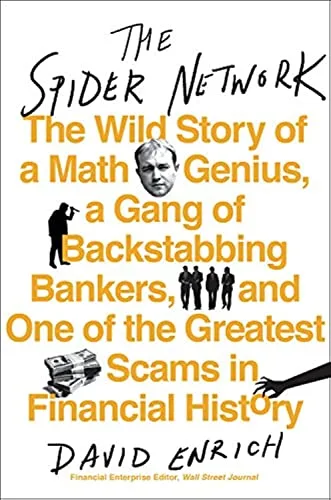
The Spider Network
The Wild Story of a Math Genius, a Gang of Backstabbing Bankers, and One of the Greatest Scams in Financial History
by David Enrich
- Published
- 2017
- Pages
- 528 pages
- Publisher
- Custom House
- Readers
- 4 members have read this
David Enrich's account of the Libor rate-rigging scandal, built around Tom Hayes, the awkward, brilliant yen derivatives trader at UBS and Citigroup who leaned on brokers and rival traders to nudge a benchmark behind trillions of dollars of loans and contracts. It shows how a flawed benchmark, bonus culture and lax oversight let manipulation become routine.
Libor was supposed to measure what banks paid to borrow from each other. In practice it was a daily set of estimates from a handful of banks, and a loose network of traders and brokers learned how easily those estimates could be pushed. Enrich tells the story through Tom Hayes, the star yen derivatives trader convicted by a London jury in 2015 of conspiring to rig the rate.
Enrich covered the scandal for The Wall Street Journal and secured unusual access to Hayes himself, alongside chat logs, emails and interviews with brokers, bankers and investigators. The result is a character study as much as a financial history. It was shortlisted for the 2017 Financial Times and McKinsey Business Book of the Year.
Reviewers in The New York Times compared its pace to a John le Carré thriller. The common reservation is that Enrich is sympathetic to Hayes, whose sentence he treats as out of proportion to his role. The Washington Post found the cast sprawling, and the AV Club warned that the first 75 or so pages of Libor mechanics are dry. Later events add weight to his doubts: in July 2025 the UK Supreme Court quashed Hayes's conviction.
Read it for the clearest narrative account of how a benchmark failed and who paid for it. It pairs well with books on the 2008 crisis because it shows the plumbing rather than the balance sheets.
- A benchmark built on estimates invites gaming. Libor relied on what banks said they could borrow at, not on executed trades, so a few basis points of discretion could be steered toward a trading book.
- Brokers are an information network, and a channel for abuse. The interdealer brokers who sat between banks could relay requests to many submitters at once, which is how one trader's wishes reached several panels.
- Incentives set the culture. At UBS and elsewhere, profit was the main test of a trader's worth, and supervisors who benefited from the results had little reason to ask how they were earned.
- Accountability ran downhill. Banks paid regulatory fines and a few mid-level traders faced trial, while the senior managers who built the incentives largely kept their careers.
- Practices that feel routine can become crimes. Hayes insisted he did what the market did. Courts first rejected that, then in 2025 the UK Supreme Court quashed his conviction over the jury directions, a reminder that legal risk around market conduct is uncertain and slow to resolve.
The book moves chronologically from the mechanics of the scam to the trials that followed.
- The benchmark and the trader. Enrich explains how Libor was set from bank estimates rather than real trades, and introduces Hayes, whose talent for numbers and social difficulties shaped his rise at UBS, where profit was the only measure that mattered.
- Building the web. Hayes recruits interdealer brokers, among them Darrell Read and Terry Farr, and traders at other banks to lean on submissions in his favor. Enrich details the perks, payments and lavish lifestyles that kept the brokers cooperating.
- Peak and fall. Hayes moves to Citigroup, his positions grow, and regulators begin to circle. Banks, UBS among them, cast him as the mastermind as investigations widen.
- Prosecution. To avoid extradition to the United States, Hayes first confesses to Britain's Serious Fraud Office, then recants and fights the charges. A London jury convicts him in 2015 and he is sentenced to 14 years, cut to 11 on appeal.
- Aftermath. The brokers tried in the case, Read and Farr among them, are acquitted in early 2016, leaving Hayes as the scandal's lone face in the dock. Banks pay billions in fines while the senior executives who built the incentives escape charges, and Hayes keeps insisting he did only what the market did.
In 2006, an oddball group of bankers, traders and brokers from some of the largest financial institutions made a startling realization: LIBOR, the London interbank offered rate, which determines the interest rates on trillions in loans worldwide was set daily by a small group of easily manipulated administrators, and that they could reap huge profits by nudging it fractions of a percent to suit their trading portfolios. Tom Hayes, a brilliant but troubled mathematician, became the lynchpin of a wild alliance that included a prickly French trader nicknamed ?eoeGollum?e ; the broker ?eoeAbbo,?e who liked to publicly strip naked when drinking; a nervous Kazakh chicken farmer known as ?eoeDerka Derka?e ; a broker known as ?eoeVillage?e (short for ?eoeVillage Idiot?e ) who racked up huge expense account bills; an executive called ?eoeClumpy?e because of his patchwork hair loss; and a broker uncreatively nicknamed ?eoeBig Nose?e who had once been a semi-professional boxer. This group generated incredible riches ?euntil it all unraveled in spectacularly vicious, backstabbing fashion. With exclusive access to key characters and evidence, The Spider Network is not only a rollicking account of the scam, but also a provocative examination of a financial system that was crooked throughout.
Reader reviews
No reviews yet. Join to write the first one.