
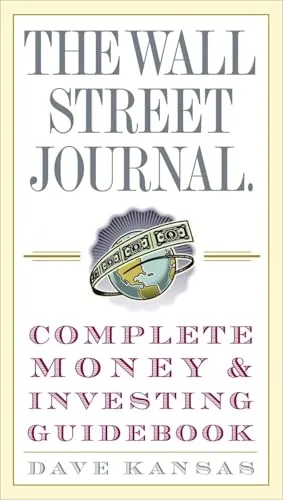
The Wall Street Journal Complete Money and Investing Guidebook
by Dave Kansas
- Published
- 2005
- Pages
- 224 pages
- Publisher
- Three Rivers Press
- Readers
- 0 members have read this
A compact primer from the editor of the Wall Street Journal's Money & Investing section that walks through stocks, bonds, mutual funds, retirement accounts, private money, derivatives and real estate. It is a fast way to learn how the markets fit together and what the financial pages are talking about, though not a manual for building a portfolio.
This slim paperback, part of the Journal's guidebook series, is built for someone who reads the business section and wants the plumbing explained. Dave Kansas moves asset class by asset class, explaining what each instrument is, who trades it, how prices are quoted and what moves them, with charts, graphs and sidebars on topics such as how to read a stock listing and the history of the Dow Jones Industrial Average.
Kansas wrote it from inside financial journalism. He was a Journal reporter, then editor-in-chief of TheStreet.com in its formative years, and had returned to the paper to run its Money & Investing section. That background shows in the book's willingness to cover Wall Street's conflicts, including Henry Blodget's discredited stock recommendations from the bubble years.
Reviewers split on who it is for. Kirkus, as quoted by Steven Levitt, said it covered all you need to know about money and investing in a slim 200 pages. Publishers Weekly found it neither a hands-on manual nor a basic introduction, with simple analogies giving way to jargon that may overwhelm novices, but enjoyed Kansas's dry humor and judged it most useful for readers who already know a little about trading and economics.
The market details date from the mid-2000s, before the financial crisis and the shift to low-cost index funds and ETFs, so treat the specifics as history. As a vocabulary builder for interns, career switchers and students, it still does the job quickly.
- Learn the vocabulary first. Much of what makes markets seem opaque is jargon, and the book's main gift is making stock tables, bond quotes and Wall Street shorthand readable.
- Treat each asset class as its own market. Stocks, bonds, funds, derivatives and real estate have different players, pricing conventions and risks, and the chapter-by-chapter layout trains you to ask what is specific to each.
- Watch the economy. Kansas argues that individual investors cannot ignore economic news, because it moves prices across every market he covers.
- Know who is on the other side. Analysts, brokers and bankers have their own incentives, as the bubble-era research scandals around figures such as Henry Blodget showed.
- Respect the risk in private and exotic assets. Venture capital, options and futures can pay off spectacularly, and Kansas is blunt that they carry far more risk than mainstream investments.
The book is arranged as a tour of the financial system in nine chapters, each a self-contained briefing on one corner of the markets.
- Stocks and bonds. The opening chapters explain equity and debt: what shares and bonds represent, how they are issued and traded, how prices and yields are quoted, and how to read the tables.
- Wall Street. Kansas introduces the institutions and players, using everyday analogies for the New York Stock Exchange and its specialists, and does not shy away from the research conflicts that surfaced after the dot-com bust.
- Economics and money. This chapter explains why individual investors should watch the economy and how economic news feeds into prices.
- Mutual funds and retirement investing. He explains how funds work and what to check before buying one, then turns to investing for retirement.
- Private money. A chapter on capital outside the public markets, including venture capital, which he treats as a high-risk business.
- Options, futures, real estate and other assets. The closing chapters cover derivatives and non-traditional investments, then real estate as an investment.
Unravel the Mysteries of the Financial Markets—the Language, the Players, and the Strategies for Success Understanding money and investing has never been more important than it is today, as many of us are called upon to manage our own retirement planning, college savings funds, and health-care costs. Up-to-date and expertly written, The Wall Street Journal Complete Money and Investing Guidebook provides investors with a simple—but not simplistic—grounding in the world of finance. It breaks down the basics of how money and investing work, explaining: • What must-have information you need to invest in stocks, bonds, and mutual funds • How to see through the inscrutable theories and arcane jargon of financial insiders and advisers • What market players, investing strategies, and money and investing history you should know • Why individual investors should pay attention to the economy Written in a clear, engaging style by Dave Kansas, one of America’s top business journalists and editor of The Wall Street Journal Money & Investing section, this straightforward book is full of helpful charts, graphs, and illustrations and is an essential source for novice and experienced investors alike. Get your financial life in order with help from The Wall Street Journal. Look for: • The Wall Street Journal Complete Personal Finance Guidebook • The Wall Street Journal Personal Finance Workbook • The Wall Street Journal Complete Real Estate Investing Guidebook
Reader reviews
No reviews yet. Join to write the first one.