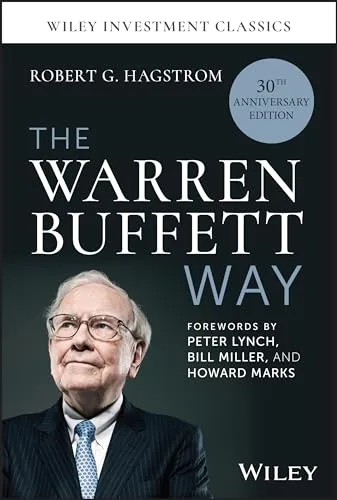
The Warren Buffett Way
- Published
- 1994
- Pages
- 352 pages
- Publisher
- Wiley
- Readers
- 3 members have read this
Robert Hagstrom's long-running guide boils Warren Buffett's method down to twelve tenets covering the business, its management, its financials and its price. Updated for its 30th anniversary, it is the most accessible single-volume map of how Buffett picks and holds stocks, built from Berkshire Hathaway's letters and filings and worked through real purchases.
First published in 1994, The Warren Buffett Way became a New York Times bestseller and, for many investors, the standard explanation of how Buffett actually picks stocks. Hagstrom treats a share as a fractional claim on a business and organizes Buffett's thinking into twelve tenets covering the business, its management, its financial returns and the price paid.
Hagstrom is a working money manager, now chief investment officer of EquityCompass Investment Management and formerly a portfolio manager at Legg Mason, who has studied Buffett since the mid-1980s. He did not interview Buffett for the original book. Publishers Weekly noted at the time that he worked from Berkshire Hathaway annual reports, and that gives the book its strength and its limit: it is a careful reading of the public record rather than an inside account.
The 2024 edition adds more on Charlie Munger's worldly wisdom and references to the academic research behind Buffett's approach, and keeps the forewords by Peter Lynch, Bill Miller and Howard Marks. Readers should remember that the twelve tenets are Hagstrom's codification, not Buffett's own checklist, and that the book is admiring throughout. For biography, turn to Alice Schroeder's The Snowball or Roger Lowenstein's Buffett; for the primary source, read the shareholder letters.
As a structured starting point for a new analyst, this remains the clearest framework available.
- Buy the business, not the ticker. Every tenet starts from the idea that a share is a piece of an operating company, so the analysis looks like an acquirer's, not a trader's.
- Judge management on capital allocation. Rational reinvestment, candor with shareholders and refusal to copy peers' bad deals, the institutional imperative, matter as much as the operating numbers.
- Use owner earnings and return on equity. Net income plus depreciation, less the capital spending needed to sustain the business, says more about value than reported earnings per share.
- Test retained earnings. Each dollar a company keeps should create at least a dollar of market value over time, or management should return it.
- Concentrate and wait. Buffett's record came from a few large positions held for years, which demands the temperament to sit through volatility rather than chase it.
The 30th anniversary edition runs seven chapters, moving from Buffett's background to his method, his portfolio construction and the temperament it requires.
- The investor and his teachers. The opening chapters sketch Buffett's record and trace the ideas he absorbed from Benjamin Graham's margin of safety, Philip Fisher's focus on business quality and Charlie Munger's push toward great companies at fair prices.
- Business-driven investing. The core chapter sets out the twelve tenets in four groups, covering the business, management, financial measures such as return on equity and owner earnings, and value.
- Common stock purchases. Hagstrom applies the tenets to five Berkshire investments: The Washington Post Company, GEICO, Capital Cities/ABC, Coca-Cola and Apple.
- Managing a portfolio of businesses. He explains focus investing, Buffett's concentrated, low-turnover approach and the subject of Hagstrom's follow-up book, revisits the superinvestors argument, and makes the case for high active share over conventional diversification.
- The case for active management. A chapter on the high priests of modern finance and the efficient market hypothesis separates investment from speculation and argues that the trouble with active management is how it is practiced, not the idea itself.
- Money mind. The closing chapter turns to the temperament and psychology of long-term investing and to Berkshire as an institution, followed by appendices on Berkshire's record against the S&P 500 and its stock portfolios.
Reader reviews
No reviews yet. Join to write the first one.