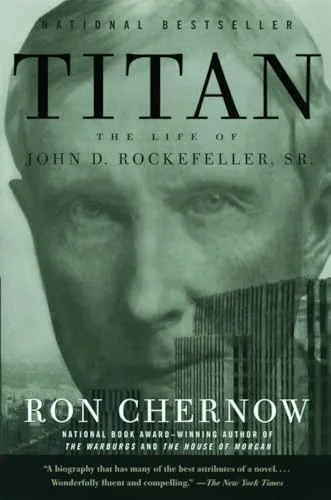
Titan
The Life of John D. Rockefeller, Sr.
by Ron Chernow
- Published
- 1998
- Pages
- 832 pages
- Publisher
- Vintage
- Readers
- 3 members have read this
Ron Chernow's biography of John D. Rockefeller Sr., built from family archives and a 1,700-page transcript of interviews Rockefeller gave late in life. It follows him from Cleveland bookkeeper to master of Standard Oil and then to America's most systematic philanthropist. The essential account of how the first great American monopoly was built, attacked and broken up.
Chernow covers Rockefeller's whole life, from a childhood split between a bigamous, patent-medicine-selling father and a devout Baptist mother, through the rise of Standard Oil and its dissolution by the Supreme Court in 1911, to a forty-year retirement devoted to giving.
Chernow came to the book as a former financial journalist whose The House of Morgan won the National Book Award. He spent about five years on Titan, working in the Rockefeller Archive Center and drawing on a long transcript of private interviews with Rockefeller that earlier biographers had not used. The book was a National Book Critics Circle finalist, and Time's Lance Morrow ranked it among the great American biographies.
Its strength is balance. Kirkus noted that Rockefeller's secrecy had hampered earlier biographers, from the critic Ida Tarbell to the admiring Allan Nevins, and credited Chernow with a balanced, psychologically sharp portrait that still doesn't excuse collusion such as the South Improvement Company. Reviewers disagreed on where he landed: Jackson Lears in The New Republic thought him too lenient, while a Foundation for Economic Education reviewer argued he too readily called Standard's pricing predatory and gave the antitrust rulings less than two pages.
Read it if you work in antitrust, energy, M&A or philanthropy, or want to see how scale, logistics and cost accounting built a fortune.
- Cost control is a strategy. Rockefeller's obsession with bookkeeping, waste and scale made Standard the low-cost refiner, which let it outlast and absorb rivals in a boom-and-bust industry.
- Logistics can matter more than product. Volume leverage over the railroads, and later control of pipelines, gave Standard an edge that had little to do with refining itself.
- Consolidation invites a backlash. Secret deals, rebates and the opaque trust structure gave Tarbell and the courts the case that ended in the 1911 breakup.
- Breakups can create value. The trust's successor companies thrived after dissolution, and Rockefeller's holdings rose in value as their shares climbed.
- Run giving like a business. With Gates, Rockefeller applied due diligence and scale to philanthropy, endowing lasting institutions instead of scattering checks.
Chernow tells the story chronologically, in roughly five phases.
- Origins. Rockefeller's boyhood in upstate New York and Ohio, shaped by his con-man father William Avery Rockefeller and his pious mother Eliza, and his first job as a bookkeeper in Cleveland, where he learned to track every cent.
- Building Standard Oil. His move from produce commission merchant into refining after the Pennsylvania oil discoveries, partnerships including Henry Flagler, the founding of Standard Oil in 1870, railroad rebates, the South Improvement scheme and the absorption of most Cleveland rivals.
- The trust and its enemies. Standard's national and global dominance, its control of nearly 90 percent of American refining, the hostility it drew as the Octopus, Ida Tarbell's exposé and the federal antitrust suit that ended in the 1911 breakup.
- Giving it away. With adviser Frederick Gates, Rockefeller turned philanthropy into a system, funding the University of Chicago, medical research, education for Black Southerners and the Rockefeller Foundation.
- The long retirement. His decades of golf and public charm, his relationship with his son John D. Jr. and the remaking of his public image before his death in 1937 at 97.
National Book Critics Circle Award Finalist From the acclaimed, award-winning author of Alexander Hamilton: here is the essential, endlessly engrossing biography of John D. Rockefeller, Sr.—the Jekyll-and-Hyde of American capitalism. In the course of his nearly 98 years, Rockefeller was known as both a rapacious robber baron, whose Standard Oil Company rode roughshod over an industry, and a philanthropist who donated money lavishly to universities and medical centers. He was the terror of his competitors, the bogeyman of reformers, the delight of caricaturists—and an utter enigma. Drawing on unprecedented access to Rockefeller’s private papers, Chernow reconstructs his subjects’ troubled origins (his father was a swindler and a bigamist) and his single-minded pursuit of wealth. But he also uncovers the profound religiosity that drove him to give all I could”; his devotion to his father; and the wry sense of humor that made him the country’s most colorful codger. Titan is a magnificent biography—balanced, revelatory, elegantly written.
Reader reviews
No reviews yet. Join to write the first one.