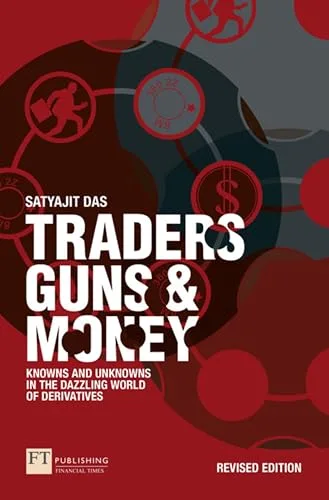
Traders, Guns and Money
Knowns and Unknowns in the Dazzling World of Derivatives
by Satyajit Das
- Published
- 2006
- Pages
- 440 pages
- Publisher
- FT Publishing International
- Readers
- 1 member has read this
A derivatives veteran's sardonic tour of how swaps, structured notes, credit default swaps and CDOs are really sold, priced and risk-managed. First published in 2006, before the credit crisis, it explains how banks turned hedging tools into leveraged bets and why clients so often lose. Few books show the sell side's incentives this plainly.
Satyajit Das spent three decades inside the derivatives business, at Commonwealth Bank of Australia, Citicorp Investment Bank and Merrill Lynch and as treasurer of the TNT transport group, before becoming a consultant and the author of standard technical references on swaps and credit derivatives. This book is his version for general readers: a funny, cynical account of how trading rooms make money from products that customers rarely understand.
His central argument is that derivatives began as insurance against price swings and turned into instruments for taking on risk. Banks package leverage into what he calls risk cocktails, sell them to companies and investors who think they are hedging, and price them with models that look precise and are not. Gillian Tett in the Financial Times called it timely and pitched at readers put off by the mathematics, and James Pressley at Bloomberg found it funny and readable, an ideal primer.
The original edition warned that risk was being concentrated rather than spread; the 2010 revised edition adds an afterword on the credit crunch. Readers expecting a single narrative like Liar's Poker should know it is organized by theme, and the war stories are told with heavy irony.
It suits anyone on a structured products, sales or treasury desk, and any buyer of derivatives who wants to know how the other side thinks.
- Know who is on the other side. Dealers design structured products to earn fees and shed risk. If a product is complex, assume the complexity benefits the seller.
- Hedges can become bets. Derivatives often start as insurance and end as leveraged speculation. Check whether a position offsets a real exposure or simply adds a new one.
- Models are not reality. Pricing and value-at-risk models rest on assumptions about correlation and volatility that fail exactly when markets are stressed.
- Incentives drive behavior. Bonus systems reward volume and short-term profit, which pushes desks toward riskier, more opaque products.
- Spreading risk can concentrate it. Credit derivatives were meant to disperse risk, but leverage and interlinked dealers left it concentrated in a few institutions.
Das organizes the book by theme rather than by chronology, moving from the people who sell derivatives to the products themselves and then to the credit markets that broke in 2007.
- The case against derivatives. The opening chapter takes up Warren Buffett's description of derivatives as financial weapons of mass destruction and sorts the substance from the rhetoric.
- Sell side and buy side. Two chapters look at the dealers who design and market the products and the corporate treasurers, fund managers and investors who buy them, often with poor information and misaligned incentives.
- Pay and risk management. Das turns to bonuses and the culture of the trading floor, then to risk management, where value-at-risk and other metrics give a false sense of control.
- Models and structured products. Chapters on pricing algorithms and structured notes show how complexity is used to hide fees and leverage, and how products are built so that clients take risks they cannot see.
- Equity and credit derivatives. The final chapters cover equity derivatives and then credit default swaps and CDOs, which became the center of the 2007 to 2008 crisis.
- Afterword. In the revised edition, Das looks back at the credit crunch and argues that the failures he described played a central part in it.
Traders Guns and Money is a wickedly comic exposé of the culture, games and pure deceptions played out every day in trading rooms around the world. And played out with other people’s money. A sensational insider’s view of the business of trading and marketing derivatives, this revised edition explains the frighteningly central role that derivatives and financial products played in the global financial crisis. This worldwide bestseller reveals the truth about derivatives: those financial tools memorably described by Warren Buffett as ‘financial weapons of mass destruction’. Traders, Guns and Money will introduce you to the players and the practices and reveals how the real money is made and lost. The global financial crisis took almost everyone by surprise and even now new problems keep appearing and solutions continue to be elusive. In the original version of Traders, Guns and Money, Satyajit Das provided a highly prescient insight into the structure and risk of the world financial system exposing the problems that are becoming readily apparent. In a 2006 speech – The Coming Credit Crash – Das argued that: an informed analysis … shows that risk is not better spread but more leveraged and (arguably) more concentrated…. This does not improve the overall stability and security of the financial system but exposes it to increased risk of a crash.
Reader reviews
No reviews yet. Join to write the first one.