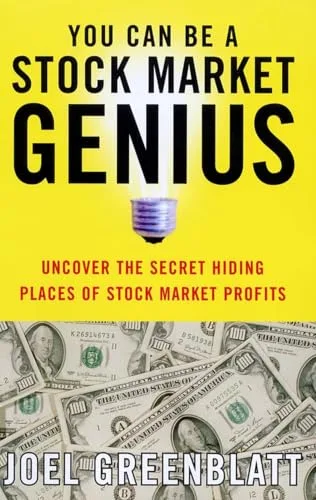
You Can Be a Stock Market Genius
Uncover the Secret Hiding Places of Stock Market Profits
- Published
- 1997
- Pages
- 304 pages
- Publisher
- Touchstone
- Readers
- 4 members have read this
Hedge fund manager Joel Greenblatt explains the special-situation investing that earned Gotham Capital about 50 percent a year before fees from 1985 to 1994: spinoffs, merger securities, bankruptcies, recapitalizations, stub stocks and LEAPS. Despite the joke title, it is one of the most practical books on finding mispriced securities where institutions are not looking.
Greenblatt's argument is that the best opportunities sit in corporate events that most investors ignore or are forced to mishandle. When a company spins off a division, for example, index funds and institutions often dump the new shares because they are too small or outside their mandate, regardless of value. He walks through each type of event, from spinoffs to bankruptcies and restructurings, using real trades as case studies.
The credentials are strong. Greenblatt founded Gotham Capital in 1985 and returned outside capital in 1995 after a decade of roughly 50 percent annualized returns before the general partner's share, earned largely in special situations. He taught value investing at Columbia Business School and later co-founded the Value Investors Club. This 1997 book predates The Little Book That Beats the Market and its magic formula, which is a different, quantitative approach.
The book became a cult classic among event-driven and value investors. The Motley Fool's reviewer warned that it is not for beginning investors, and InvestmentNews noted that the examples are dated and that some of the plays are harder to execute in today's faster, more competitive markets. The tone is breezy and self-mocking, which makes the technical material easier to absorb.
It is essential reading for anyone working in event-driven, distressed or special-situations investing, and for analysts who want to learn to look past the headline numbers.
- Follow the forced sellers. Spinoff shares often fall at first because institutions sell them for reasons unrelated to value.
- Watch what insiders want. Greenblatt looks for spinoffs where managers get stock in the new company and incentives line up with shareholders.
- Complexity hides value. A conglomerate's best business can be masked by weaker ones until a spinoff or restructuring separates them.
- Concentrate on your best ideas. He argues that a portfolio of six to eight well-researched stocks across industries captures most diversification benefits.
- Limit the downside first. A margin of safety matters more than upside, especially in merger arbitrage, where a broken deal can wipe out years of small gains.
The book opens with Greenblatt's general approach and then devotes a chapter to each kind of special situation.
- The small investor's edge. Greenblatt argues that individuals can focus on their best handful of ideas, judge results over years and wait for a fat pitch, and that six to eight stocks provide most of the benefit of diversification.
- Spinoffs. The longest section explains why spun-off shares are often sold indiscriminately, and uses cases such as Marriott's split into Host Marriott and Marriott International and Sears's separation of Dean Witter and Allstate.
- Risk arbitrage and merger securities. He explains why he mostly avoids standard merger arbitrage, and why the unusual securities issued in some mergers can be mispriced.
- Bankruptcy and restructuring. He shows where value can appear in the new stock of companies emerging from bankruptcy and in restructurings.
- Recapitalizations, stub stocks and options. The final chapters cover leveraged recapitalizations that leave a small, high-upside stub of equity, plus LEAPS, warrants and other options as cheap ways to take leveraged positions in mispriced situations.
A comprehensive and practical guide to the stock market from a successful fund manager—filled with case studies, important background information, and all the tools you’ll need to become a stock market genius. Fund manager Joel Greenblatt has been beating the Dow (with returns of 50 percent a year) for more than a decade. And now, in this highly accessible guide, he’s going to show you how to do it, too. You’re about to discover investment opportunities that portfolio managers, business-school professors, and top investment experts regularly miss—uncharted areas where the individual investor has a huge advantage over the Wall Street wizards. Here is your personal treasure map to special situations in which big profits are possible, including: · Spin-offs · Restructurings · Merger Securities · Rights Offerings · Recapitalizations · Bankruptcies · Risk Arbitrage
Reader reviews
No reviews yet. Join to write the first one.