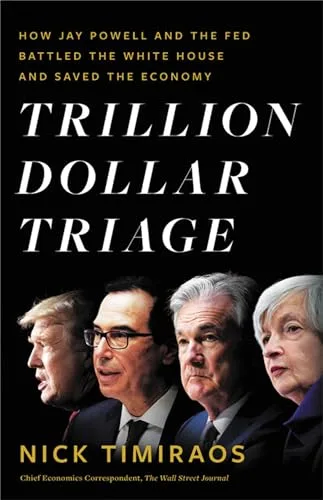
Trillion Dollar Triage
How Jay Powell and the Fed Battled a President and a Pandemic—and Prevented Economic Disaster
- Published
- 2022
- Pages
- 352 pages
- Publisher
- Little, Brown and Company
- Readers
- 2 members have read this
The Wall Street Journal's chief Fed reporter tells the inside story of Jerome Powell's first years as chair: Donald Trump's public attacks over interest rates, then the March 2020 panic, when the Fed cut rates to zero, bought bonds on a vast scale and lent to markets it had never backstopped before. It is the closest thing to a minute-by-minute record of how the modern crisis playbook was written.
Nick Timiraos covers Powell's Fed from his arrival as chair in February 2018 to mid-2021. The first part is a political story, as Trump attacked Powell for raising rates. The second is a crisis story, as Covid-19 shut down the economy, the Treasury market seized up and the Fed cut rates to near zero, bought bonds in enormous volumes and set up emergency lending programs.
Timiraos joined the Journal in 2006, covered the housing bust and became its chief economics correspondent, with unusual access to Fed officials. This is his first book. It also covers Powell's background and gives a short history of the Fed.
The reporting earned wide praise. Jason Furman in the Washington Post singled out its detailed, original reporting, and blurbs came from Warren Buffett, Alan Blinder and David Wessel. The main caveat is timing. The narrative largely ends in mid-2021, just as inflation was starting to climb, and Furman noted that the pages on the fight against it read like a rough draft of unfinished history. Publishers Weekly pointed out that some critics blame the rescue for that inflation. A review by Vern McKinley, titled Was It Really Triage?, questioned the book's framing of the rescue.
Anyone in fixed income, macro or bank treasury should read it to understand the tools the Fed will reach for in the next crisis. Pair it with Christopher Leonard's The Lords of Easy Money for the opposing case.
- The Fed now backstops markets, not just banks. In 2020 it lent against corporate bonds, municipal debt and other assets, setting a precedent that investors will price into the next crisis.
- Treasury liquidity can fail. Even the deepest bond market seized up in March 2020. Liquidity assumptions in risk models need a stress case for Treasuries too.
- Speed beats precision in a panic. Timiraos shows officials choosing to act fast and fix flaws later, the triage of the title. Expect the same order of priorities next time.
- Fed independence is tested in public. Trump's attacks on Powell showed how political pressure can play out in tweets as well as private calls, and why markets watch that pressure closely.
- Rescues have costs that show up later. The book closes as inflation was only beginning to rise, before the surge of 2022. Reading it now shows how quickly a well-executed rescue can become the starting point for the next problem.
The book moves chronologically from Powell's appointment through the pandemic response.
- Powell's path. Timiraos traces Powell's career as a lawyer, a Treasury official and a private-equity partner, and his nomination to the Fed board by Barack Obama in 2011, with background on how the central bank works.
- The Trump pressure. After Trump interviews candidates and picks Powell in 2017, the president turns on him over rate increases. The Fed raises rates through 2018, then pivots in 2019 as Trump keeps up his public attacks.
- March 2020. As Covid-19 spreads, markets for Treasuries, commercial paper and corporate debt freeze. The Fed cuts rates to near zero and buys bonds at record speed.
- Building the backstops. With Mnuchin and Congress, the Fed launches emergency lending programs for businesses, municipalities and credit markets, crossing lines it had avoided even in 2008.
- The recovery question. By 2021 the economy is rebounding, and Timiraos lays out the dilemma Powell faces: how to support a recovery without setting off inflation or excessive risk-taking, and what moral hazard the rescue left behind.
The inside story, told with insight, perspective, and stellar reporting,” of how an unassuming civil servant created trillions of dollars from thin air, combatted a public health crisis, and saved the American economy from a second Great Depression (Alan S. Blinder, former Vice Chair of the Federal Reserve). By February 2020, the U.S. economic expansion had become the longest on record. Unemployment was plumbing half-century lows. Stock markets soared to new highs. One month later, the public health battle against a deadly virus had pushed the economy into the equivalent of a medically induced coma. America’s workplaces—offices, shops, malls, and factories—shuttered. Many of the nation’s largest employers and tens of thousands of small businesses faced ruin. Over 22 million American jobs were lost. The extreme uncertainty led to some of the largest daily drops ever in the stock market. Nick Timiraos, the Wall Street Journal’s chief economics correspondent, draws on extensive interviews to detail the tense meetings, late night phone calls, and crucial video conferences behind the largest, swiftest U.S. economic policy response since World War II. Trillion Dollar Triage goes inside the Federal Reserve, one of the country’s most important and least understood institutions, to chronicle how its plainspoken chairman, Jay Powell, unleashed an unprecedented monetary barrage to keep the economy on life support. With the bleeding stemmed, the Fed faced a new challenge: How to nurture a recovery without unleashing an inflation-fueling, bubble-blowing money bomb? Trillion Dollar Triage is the definitive, gripping history of a creative and unprecedented battle to shield the American economy from the twin threats of a public health disaster and economic crisis. Economic theory and policy will never be the same.
Reader reviews
No reviews yet. Join to write the first one.