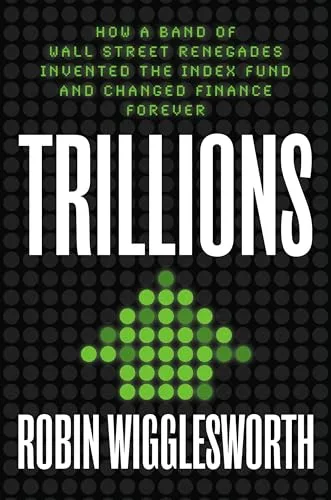
Trillions
How a Band of Wall Street Renegades Invented the Index Fund and Changed Finance Forever
- Published
- 2021
- Pages
- 352 pages
- Publisher
- Portfolio
- Readers
- 2 members have read this
The Financial Times's global finance correspondent tells the history of passive investing, from Louis Bachelier's random walk and the Chicago efficient-market school to Wells Fargo's first index fund, Jack Bogle's Vanguard, the ETF and BlackRock's iShares. It ends by asking what happens when a handful of index giants own a big share of every company.
Index funds now hold trillions of dollars, and Robin Wigglesworth argues that they are among the most important financial inventions of the past century. He tells the story through the people who made them possible, from academics such as Harry Markowitz, William Sharpe and Eugene Fama to Bogle and Vanguard and the inventors of the exchange-traded fund.
Wigglesworth covers markets for the Financial Times, and he writes about academics and fund executives as characters rather than footnotes. The last chapters take on the critics: the power of index committees, ETFs that drift toward active bets, and the voting clout of BlackRock, Vanguard and State Street.
A CFA Institute reviewer called it entertaining and thought-provoking. A London School of Economics reviewer found it light on the risks of passive investing, US-centric and inclined to tell success stories about elite figures.
It is a natural first book on the subject for analysts and new hires, and it pairs well with Eric Balchunas's The Bogle Effect.
- Costs compound like returns. The core case for indexing is arithmetic: after fees, the average active dollar must trail the market. Buffett's bet showed the gap over a decade.
- Ideas wait for products. The efficient-market research sat in journals for years. It changed finance only when Wells Fargo, Vanguard and later ETF sponsors packaged it for clients.
- Ownership structure shapes behavior. Vanguard's mutual structure, with the funds owning the manager, let Bogle keep cutting fees in a way shareholder-owned rivals resisted.
- Passive is full of choices. Index committees decide what counts as tech or which countries are emerging markets, and their decisions move prices. Know who builds the index you own.
- Concentration is the open question. Three managers now cast a large share of shareholder votes. That power is the main unresolved issue the index revolution leaves behind.
The book moves roughly in chronological order, from theory to product to consequences.
- The bet. Buffett's wager with Protégé Partners sets up the question of why low-cost indexing beats most professional managers.
- The theorists. Bachelier's 1900 random-walk thesis is rediscovered decades later, and Markowitz, Sharpe, Fama and others build modern portfolio theory and the efficient-market hypothesis.
- The first funds. McQuown's group at Wells Fargo turns the theory into a product for institutional clients, and Fama's students David Booth and Rex Sinquefield carry the ideas into business.
- Bogle's Vanguard. Bogle launches the First Index Investment Trust in 1976, raises far less than hoped, survives the ridicule, and builds the mutual-owned giant that drives fees down across the industry.
- The ETF and the giants. Nate Most's idea becomes State Street's SPDR, and BlackRock's purchase of BGI makes iShares the dominant ETF brand.
- Too powerful? Wigglesworth weighs concentrated ownership, proxy voting, the influence of index providers and the strain that cheap passive products put on the rest of the investment business.
From the Financial Times's global finance correspondent, the incredible true story of the iconoclastic geeks who defied conventional wisdom and endured Wall Street's scorn to launch the index fund revolution, democratizing investing and saving hundreds of billions of dollars in fees that would have otherwise lined fat cats' pockets. Fifty years ago, the Manhattan Project of money management was quietly assembled in the financial industry's backwaters, unified by the heretical idea that even many of the world's finest investors couldn't beat the market in the long run. The motley crew of nerds—including economist wunderkind Gene Fama, humiliated industry executive Jack Bogle, bull-headed and computer-obsessive John McQuown, and avuncular former WWII submariner Nate Most—succeeded beyond their wildest dreams. Passive investing now accounts for more than $20 trillion, equal to the entire gross domestic product of the US, and is today a force reshaping markets, finance and even capitalism itself in myriad subtle but pivotal ways. Yet even some fans of index funds and ETFs are growing perturbed that their swelling heft is destabilizing markets, wrecking the investment industry and leading to an unwelcome concentration of power in fewer and fewer hands. In Trillions, Financial Times journalist Robin Wigglesworth unveils the vivid secret history of an invention Wall Street wishes was never created, bringing to life the characters behind its birth, growth, and evolution into a world-conquering phenomenon. This engrossing narrative is essential reading for anyone who wants to understand modern finance—and one of the most pressing financial uncertainties of our time.
Reader reviews
No reviews yet. Join to write the first one.