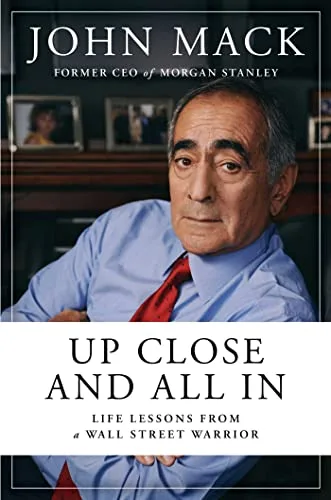
Up Close and All In
Life Lessons from a Wall Street Warrior
by John Mack
- Published
- 2022
- Pages
- 320 pages
- Publisher
- Simon Element
- Readers
- 2 members have read this
The former Morgan Stanley CEO tells his own story, from a North Carolina mill town to the bond desk, the Dean Witter merger, his ouster by Phil Purcell, Credit Suisse First Boston, and the September 2008 run that nearly sank Morgan Stanley. It is a candid look at how a Wall Street firm is run, and how its leader manages people under pressure.
John Mack spent most of four decades at Morgan Stanley, rising from bond salesman in 1972 to president, losing a power struggle with Phil Purcell in 2001 and coming back as chairman and CEO in 2005. The memoir covers all of it, starting with his childhood in Mooresville, North Carolina, as the son of a Lebanese immigrant.
The set piece is the 2008 crisis, when Mack refused government pressure to sell Morgan Stanley for a token price. Few accounts of that autumn come from someone who was in the room.
The book is organized around lessons as much as events: treat support staff with respect, confront difficult people instead of avoiding them, and don't let any executive build a fiefdom. Kirkus found it refreshingly plainspoken but called much of the advice familiar. The Swiss outlet finews was harsher, reading the book as a self-flattering monument and noting how far the expense-account culture it describes has fallen out of favor.
It suits readers who want a first-person view of how a bulge-bracket firm is managed, and of what the man nicknamed Mack the Knife thinks he got right.
- Culture is set by small acts. Mack's story of berating a trader who left a deliveryman waiting shows how a leader signals that respect for everyone is not optional.
- Confront problems directly. He argues that avoiding hard conversations with difficult people costs more than having them, whether the issue is a rogue producer or a failing division.
- Don't let anyone own a fiefdom. Mack calls handing any executive a fiefdom a terrible idea, because power centers loyal to one person undercut the firm-wide culture he was trying to build.
- In a run, liquidity and a strong partner decide survival. The 2008 chapters show how quickly confidence evaporated, and how bank holding company status and Mitsubishi UFJ's capital bought Morgan Stanley time.
- Mergers are won or lost on governance. The Dean Witter deal created scale, but the fight over who would run the combined firm cost Mack his job for more than four years.
The memoir runs chronologically, with each episode framed as a lesson.
- Mill town to Wall Street. Mack grows up in a Lebanese Catholic family in North Carolina, goes to Duke on a football scholarship, and starts his Wall Street career at Smith Barney before moving to Morgan Stanley as a bond salesman in 1972.
- Building the firm. He rises through fixed income to the presidency in 1993 and helps engineer the 1997 merger with Dean Witter, Discover & Co. that made Morgan Stanley one of the largest firms on the Street.
- Exile. After losing the fight with Phil Purcell over control of the combined firm, Mack leaves in 2001 and takes over Credit Suisse First Boston, where he cuts about 10,000 jobs and tries to clean up the culture before his contract is not renewed.
- Return and crisis. Brought back in 2005, he faces the collapse of Lehman Brothers in September 2008. Mack describes the run on Morgan Stanley, his refusal to sell under pressure, the conversion to a bank holding company, and the Mitsubishi UFJ deal that kept the firm independent.
- Afterward. He steps down as CEO at the start of 2010 and as chairman at the end of 2011, and reflects on leadership and loyalty.
From John Mack, former CEO of Morgan Stanley, an intimate personal memoir and riveting business story, recounting how he helped grow the company from 300 to 50,000 employees over four decades, transformed a notoriously competitive culture into a successful and collaborative one, and lead the company through the 2008 financial crisis. During his thirty-four-year tenure at Morgan Stanley, John Mack’s goal was to build the strongest and most productive team on Wall Street. His ability to motivate his employees to do their best work, especially in times of crisis, was fostered by his willingness to slash through bureaucracy and stand up to powerful interests. A forceful personality, one journalist said Mack was described as ‘charismatic’ so regularly that it could be part of his name.” In Up Close and All In, Mack traces his personal journey from a one-stoplight North Carolina mill town to a fortieth-floor corner office on Wall Street—and shares the life lessons he learned along the way. He developed a titanium-strength stomach for risk, stress, and competition while landing accounts early in his career, as investment banks fought like wolfpacks to take advantage of new deregulation, fielding business raids, booms, and busts. As he rose through the ranks, he never forgot where he came from, relying on his instincts, doing what was right, and listening to his people on the front lines. This culture of trust and collaboration helped Morgan Stanley anticipate future trends before other firms, adapt quickly, and achieve record profits. This gripping memoir includes both humbling lows—like when Mack made the difficult decision to leave Morgan Stanley in 2001—and exhilarating highs—such as when he made an eleventh-hour agreement with the Japanese bank Mitsubishi to save the company during the 2008 financial crisis, having refused to give in when top regulators pressured him to sell the firm for $2 per share. With humor and honesty, Mack shares advice on both business and life: how to create a culture of team players, how to keep perspective during crises, how to make difficult decisions when all eyes are on you, and more. From a singular man who’s as unafraid to cry publicly as he is to anger some of the most powerful people in the world, this is an indispensable guide to living and leading well.
Reader reviews
No reviews yet. Join to write the first one.