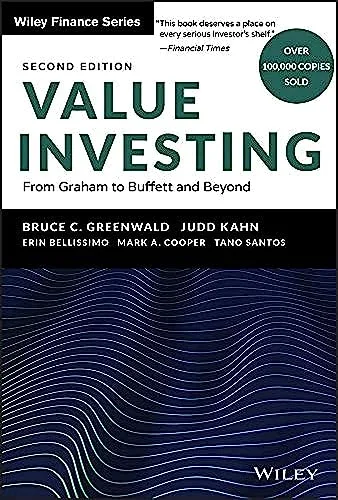
Value Investing
From Graham to Buffett and Beyond
by Bruce C. Greenwald, Judd Kahn, Erin Bellissimo, Mark A. Cooper and Tano Santos
- Published
- 2020
- Pages
- 464 pages
- Publisher
- Wiley
- Readers
- 2 members have read this
The textbook version of Columbia Business School's value investing course, rewritten for its second edition. Bruce Greenwald and his co-authors show how to find mispriced stocks, value them from assets, earnings power and franchise economics, and control risk, then profile Buffett, Klarman, Schloss and other practitioners who apply the method.
For a generation of analysts, the first edition of this book (2001) was the standard modern restatement of Graham and Dodd. The second edition is substantially rewritten. Its core is Greenwald's layered approach to valuation: start with the balance sheet and the cost of reproducing a company's assets, then capitalize its sustainable earnings with no growth assumed, and only then ask whether a durable competitive advantage justifies paying for growth. The new edition adds two chapters on valuing growth and franchise businesses, a long-standing weak spot for Graham-style investors, plus an expanded section on risk management and portfolio construction.
The authors come straight from the Columbia tradition. Greenwald was the founding director of the Heilbrunn Center for Graham and Dodd Investing and the author of Competition Demystified, and Tano Santos took over the value investing course from him.
The worked examples, including WD-40 and Intel, make the framework concrete. Reader response is divided on the new growth material. Some readers praise the three-way check of asset value, earnings power and returns, while one detailed critique argues the returns-based method breaks down for fast growers and loss-making companies, and flags typos and formula errors. The investor profiles vary in depth and in how easily others could copy their methods.
It suits analysts and MBA students who already know accounting and want a disciplined valuation process.
- Value the most reliable layer first. Asset value, then earnings power, then growth: each step adds uncertainty, so build the estimate from the parts you can measure most confidently.
- Earnings power is a no-growth test. Capitalizing sustainable earnings at the cost of capital shows what a business is worth if it never grows, and compared with asset value it reveals whether management is creating or destroying value.
- Growth only pays behind a moat. Without barriers to entry, competition drives returns down to the cost of capital and growth adds nothing, so check franchise strength before paying up.
- Think in returns, not targets. For franchise businesses the authors suggest estimating the return earned at today's price, from the cash yield plus organic and reinvested growth, and comparing it with the cost of capital.
- Know why the seller is selling. Bargains come from forced, uninformed or emotional sellers. Research effort pays most in neglected, unglamorous and out-of-favor securities.
The book opens with principles and moves through valuation method, worked examples and practice, and closes with profiles of practitioners.
- Principles and search. Opening chapters define value investing, review the evidence on its returns and risks, and explain how to search for bargains, emphasizing being on the right side of the trade when someone else is selling for non-economic reasons.
- Asset value and earnings power. The authors move from valuation in principle to practice, estimating asset value from book value up to reproduction cost (with Hudson General as the example) and then earnings power value, the no-growth capitalized value of sustainable earnings (illustrated with Magna International).
- Growth and franchises. Chapters on growth, what makes a good business and valuing franchise stocks argue that growth creates value only behind barriers to entry. A returns-based method, which treats the price paid as a cash yield plus growth, is applied to WD-40 and Intel.
- Research and risk. A chapter on research strategy and another on risk management and building portfolios turn the method into a working process.
- Investor profiles. Short portraits of Warren Buffett, Robert Heilbrunn, Walter and Edwin Schloss, Mario Gabelli, Glenn Greenberg, Paul Hilal, Jan Hummel, Seth Klarman, Michael Price, Thomas Russo and Andrew Weiss.
Let some of the best investors in the world teach you how to be on the right side of the trade. The first edition of Value Investing: From Graham to Buffett and Beyond was published in 2001. It is still in print, having sold over 100,000 copies. It has been translated into five languages. Business school professors still assign it in their courses. But in the 20 years since the first edition, the economy has changed, the investment world has evolved, and the discipline of value investing has adapted to this new environment. This second edition responds to these developments. It extends and refines an approach to investing that began with Benjamin Graham and David Dodd during the Great Depression and was adapted by Warren Buffett, Charlie Munger, and others to earn returns in an environment in which the opportunity to buy a stock worth a dollar for 50 cents is no longer waiting in plain sight. The foundation of this book is the course on value investing that Bruce Greenwald taught at Columbia Business School for almost a quarter century. His aim in the course, and our aim in the book, is to help the investor operating in the Graham and Dodd tradition find him or herself on the right side of the trade. The steps include searching for the right securities, valuing them appropriately, honing a research strategy to devote time to the right activities, and wrapping it all within a risk management practice that protects the investor from permanent loss of capital. The book has been revised throughout, but the biggest change is the addition of more than two chapters on the valuation of growth stocks, which has always been a problem for investors trained in the Graham and Dodd tradition. Successful value investing practitioners have graced both the course and this book with presentations describing what they really do when they are at work. There are brief descriptions of their practices within, and video presentations available on the web site that accompanies this volume: http://www.wiley.com/go/greenwald/valueinvesting2e In addition to a selection of Warren Buffett’s letters, there are presentations by Mario Gabelli, Glenn Greenberg, Paul Hilal, Jan Hummel, Seth Klarman, Michael Price, Thomas Russo, and Andrew Weiss. Although their styles vary, they all are members in good standing of the Graham and Dodd tradition.
Reader reviews
No reviews yet. Join to write the first one.