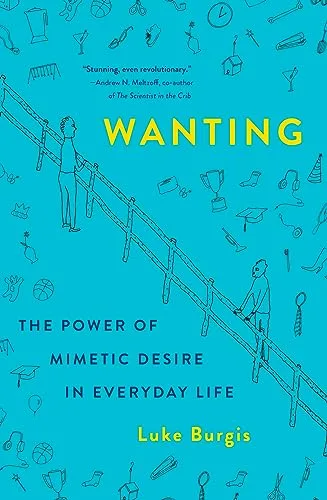
Wanting
The Power of Mimetic Desire in Everyday Life
by Luke Burgis
- Published
- 2021
- Pages
- 304 pages
- Publisher
- St. Martin's Press
- Readers
- 1 member has read this
An entrepreneur's introduction to René Girard's theory of mimetic desire: the idea that we learn what to want by copying models, and that rivalry, bubbles and scapegoating follow. Girard's ideas shaped Peter Thiel, Facebook's first outside investor. For finance readers, the book explains herd behavior in markets and careers, and how to choose goals that are your own.
Luke Burgis argues that most of what we want is borrowed. Following the French thinker René Girard, he says desire is mimetic: we pick it up from models, and the most powerful models are the ones we do not notice. The book traces what follows from mimetic desire: rivalry between people who want the same things, crises that groups resolve by finding a scapegoat, and an economy of marketers and platforms that profit from manufactured wants.
Burgis studied at NYU, worked on Wall Street, founded four companies and later became entrepreneur in residence at the Catholic University of America's Ciocca Center for Principled Entrepreneurship. He came to Girard after one of his startups folded, and reread that failure as the product of desires borrowed from his models.
Illustrated by Liana Finck, the book gives readers a vocabulary: Celebristan for distant models we admire openly, Freshmanistan for close ones we secretly compete with, and thin versus thick desires. The Times of London called it part philosophical tract and part self-help guide. The Bulletin of the Colloquium on Violence and Religion found it anecdotal rather than systematic and worried its anti-mimetic advice could be misread, and the FT allowed that readers may not fully accept Girard's concepts.
It is not a finance book, but anyone who has watched colleagues chase the same deals, jobs or hot stocks will find a useful framework here.
- Name your models. Many career and investment goals come from people you compare yourself with. Knowing who they are is the first step to deciding whether the goal is worth chasing.
- Close rivals are the dangerous ones. Competition with peers, the people in Freshmanistan, generates more envy and conflict than admiration for distant stars, which helps explain feuds inside firms and between neighboring funds.
- Markets run on borrowed conviction. Herding means prices can reflect what investors think others want. Ask whether a thesis is yours or the room's.
- Thick desires outlast thin ones. Burgis separates shallow, contagious wants from durable ones formed over time. Thin desires keep people on the treadmill of the next bonus or title.
- Watch for the scapegoat. When a group under stress fixes on one villain, the conflict usually has deeper roots in shared desire. Blame alone rarely solves the problem.
The book's eight chapters fall into two halves: the first explains how mimetic desire works, the second how to manage it.
- The hidden model. Burgis tells the story of his own company's collapse and introduces Girard's claim that desire is imitative. He separates distant models (Celebristan) from near ones (Freshmanistan) and argues that social media and a more connected world put more of our models close at hand.
- How models distort reality. He shows why models gain an almost magical hold over us, and how shared desires can become self-fulfilling, a dynamic familiar from markets.
- Rivalry and the scapegoat. Rivals forget the original prize and fixate on each other, and groups end the resulting conflict by uniting against a scapegoat, a pattern Burgis finds in offices, politics and social media.
- Changing what you want. The second half offers tactics: spot your models, choose them on purpose, slow down calculating thought, use empathy to break rivalries, and build a life around thick desires that do not depend on others' approval.
- Leading with desire. Burgis applies the ideas to organizations, arguing that leaders should set out transcendent desires rather than ask teams to copy competitors.
A groundbreaking exploration of why we want what we want, and a toolkit for freeing ourselves from chasing unfulfilling desires. Gravity affects every aspect of our physical being, but there’s a psychological force just as powerful—yet almost nobody has heard of it. It’s responsible for bringing groups of people together and pulling them apart, making certain goals attractive to some and not to others, and fueling cycles of anxiety and conflict. In Wanting, Luke Burgis draws on the work of French polymath René Girard to bring this hidden force to light and reveals how it shapes our lives and societies. According to Girard, humans don’t desire anything independently. Human desire is mimetic—we imitate what other people want. This affects the way we choose partners, friends, careers, clothes, and vacation destinations. Mimetic desire is responsible for the formation of our very identities. It explains the enduring relevancy of Shakespeare’s plays, why Peter Thiel decided to be the first investor in Facebook, and why our world is growing more divided as it becomes more connected. Wanting also shows that conflict does not arise because of our differences—it comes from our sameness. Because we learn to want what other people want, we often end up competing for the same things. Ignoring our large similarities, we cling to our perceived differences. Drawing on his experience as an entrepreneur, teacher, and student of classical philosophy and theology, Burgis shares tactics that help turn blind wanting into intentional wanting--not by trying to rid ourselves of desire, but by desiring differently. It’s possible to be more in control of the things we want, to achieve more independence from trends and bubbles, and to find more meaning in our work and lives. The future will be shaped by our desires. Wanting shows us how to desire a better one.
Reader reviews
No reviews yet. Join to write the first one.