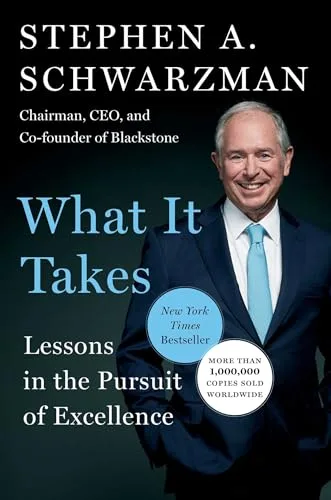
What It Takes
Lessons in the Pursuit of Excellence
- Published
- 2019
- Pages
- 384 pages
- Publisher
- Avid Reader Press / Simon & Schuster
- Readers
- 3 members have read this
Blackstone's co-founder tells how he and Pete Peterson turned $400,000 in 1985 into the world's largest alternative asset manager, and what he learned about deals, risk and building a firm along the way. It is a founder's view of how modern private equity and real estate investing were built, from a hard first fundraise to the 2007 IPO.
Stephen Schwarzman went to Yale and Harvard Business School, started in finance at Donaldson, Lufkin & Jenrette and became head of mergers and acquisitions at Lehman Brothers before founding Blackstone in 1985 with his mentor Pete Peterson. The firm began as an M&A boutique with $400,000 and by 2025 managed more than $1 trillion. The book mixes memoir and management lessons, from the long string of rejections in Blackstone's first buyout fundraise through its move into real estate and credit, the 2007 IPO, the 2008 crisis and his later philanthropy.
The most useful parts for investors are about process: how Blackstone built an investment committee that pulls a deal apart before approving it, and why his rule above all others is not to lose money. The caveat is obvious. This is a founder writing about his own firm, and it says little about criticism of private equity's fees, leverage or effect on companies. It reached the New York Times bestseller list, though as a founder's account it should be read with that in mind.
Read it with King of Capital, the outside history of Blackstone by David Carey and John Morris, for balance.
- Don't lose money. Schwarzman's first rule shapes Blackstone's whole process. Protecting against the downside comes before chasing the upside.
- Make the committee argue. Blackstone's investment reviews are built to pull deals apart from every angle, so that no single deal champion can override the risks.
- Big problems are easier to fund than small ones. Schwarzman argues that ambitious projects attract better people and capital, and take no more effort than modest ones.
- Culture is a competitive advantage. He built Blackstone partly in reaction to the infighting he saw at Lehman, and treats hiring, meritocracy and shared information as the firm's real asset.
- Learn from the mistakes that cost the most. A failed early deal and the sale of BlackRock taught him lessons about process and opportunity cost that shaped the firm for decades.
The book runs roughly in chronological order, drawing a lesson from each episode, and closes with a list of Schwarzman's rules for work and life.
- Early life and education. Growing up in his family's store in the Philadelphia suburbs, his time at Yale and Harvard Business School, and his first job at DLJ.
- Lehman Brothers. Rising to run M&A, working with Pete Peterson, and watching internal conflict lead to Lehman's 1984 sale to Shearson/American Express, which convinced him to build a firm with a different culture.
- Founding Blackstone. Starting with $400,000 and an advisory business, the long series of rejections in the first fundraise, and the eventual close after Black Monday.
- Building the machine. Early buyouts and failures, the rigorous investment committee process designed to avoid repeating mistakes, the BlackRock partnership with Larry Fink and its sale, and expansion into real estate, credit and hedge fund investing.
- Going public and the crisis. The 2007 IPO, record buyouts such as Equity Office and Hilton, and how the firm got through 2008.
- Beyond the firm. His philanthropy, including Schwarzman Scholars in Beijing and MIT's College of Computing, and his role in US-China relations and in advising Washington.
NEW YORK TIMES BESTSELLER From Blackstone chairman, CEO, and co-founder Stephen A. Schwarzman, a long-awaited book that uses impactful episodes from Schwarzman's life to show readers how to build, transform, and lead thriving organizations. Whether you are a student, entrepreneur, philanthropist, executive, or simply someone looking for ways to maximize your potential, the same lessons apply. People know who Stephen Schwarzman is—at least they think they do. He’s the man who took $400,000 and co-founded Blackstone, the investment firm that manages over $500 billion (as of January 2019). He’s the CEO whose views are sought by heads of state. He’s the billionaire philanthropist who founded Schwarzman Scholars, this century’s version of the Rhodes Scholarship, in China. But behind these achievements is a man who has spent his life learning and reflecting on what it takes to achieve excellence, make an impact, and live a life of consequence. Folding handkerchiefs in his father’s linen shop, Schwarzman dreamed of a larger life, filled with purpose and adventure. His grades and athleticism got him into Yale. After starting his career in finance with a short stint at a financial firm called DLJ, Schwarzman began working at Lehman Brothers where he ascended to run the mergers and acquisitions practice. He eventually partnered with his mentor and friend Pete Peterson to found Blackstone, vowing to create a new and different kind of financial institution. Building Blackstone into the leading global financial institution it is today didn’t come easy. Schwarzman focused intensely on culture, hiring great talent, and establishing processes that allow the firm to systematically analyze and evaluate risk. Schwarzman’s simple mantra don’t lose money” has helped Blackstone become a leading private equity and real estate investor, and manager of alternative assets for institutional investors globally. Both he and the firm are known for the rigor of their investment process, their innovative approach to deal making, the diversification of their business lines, and a conviction to be the best at everything they do. Schwarzman is also an active philanthropist, having given away more than a billion dollars. In philanthropy, as in business, he is drawn to situations where his capital and energy can be applied to drive transformative solutions and change paradigms, notably in education. He uses the skills learned over a lifetime in finance to design, establish, and support impactful and innovative organizations and initiatives. His gifts have ranged from creating a new College of Computing at MIT for the study of artificial intelligence, to establishing a first-of-its-kind student and performing arts center at Yale, to enabling the renovation of the iconic New York Public Library, to founding the Schwarzman Scholars fellowship program at Tsinghua University in Beijing—the single largest philanthropic effort in China’s history from international donors. Schwarzman’s story is an empowering, entertaining, and informative guide for anyone striving for greater personal impact. From deal making to investing, leadership to entrepreneurship, philanthropy to diplomacy, Schwarzman has lessons for how to think about ambition and scale, risk and opportunities, and how to achieve success through the relentless pursuit of excellence. Schwarzman not only offers readers a thoughtful reflection on all his own experiences, but in doing so provides a practical blueprint for success.
Reader reviews
No reviews yet. Join to write the first one.