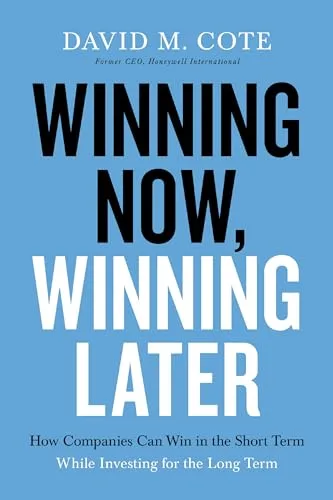
Winning Now, Winning Later
How Companies Can Succeed in the Short Term While Investing for the Long Term
- Published
- 2020
- Pages
- 288 pages
- Publisher
- HarperCollins Leadership
- Readers
- 2 members have read this
The former Honeywell chief executive explains how he hit quarterly numbers while still funding the investments that paid off years later. Cote's case against short-termism comes from running a large industrial company through a turnaround and the 2008-09 recession, which makes it useful for investors judging how management allocates money and effort.
David Cote ran Honeywell as chairman and chief executive for 16 years, a stretch in which, the publisher says, its market value grew from about $20 billion to nearly $120 billion. The book distills that run into ten principles. Its central claim is that the supposed trade-off between short- and long-term results is mostly a failure of thinking. Leaders who work through problems rigorously, run the business with disciplined processes and protect a steady stream of growth investments can satisfy investors this year and still build for the next decade. Cote is specific about the mechanics, including how metrics can be gamed and why he cleaned up the accounting.
Cote spent more than 20 years at GE, ran TRW before Honeywell, served on the Simpson-Bowles fiscal commission and later became executive chairman of Vertiv. Publishers Weekly found the advice practical but faulted the tone, saying he casts himself as the company's rescuer and is harsh about his predecessors' teams.
Investors, analysts and operating executives will get a CEO's view of capital allocation, cost discipline and planning, and a framework for asking whether a management team is borrowing from the future.
- Short versus long is a false choice. Cote argues that a company can meet this year's targets and fund the future, but only if leaders do the analytical work rather than cutting the easiest costs.
- Clean up the balance sheet early. Addressing asbestos and environmental liabilities and adopting conservative accounting removed overhangs that had depressed Honeywell's valuation.
- Prepare for recessions before they hit. Honeywell started preparing for a downturn early and used furloughs instead of mass layoffs, so it could keep skilled staff and recover faster.
- Watch what the metrics reward. Targets for new-product sales can be met with minor tweaks to old products, so leaders must check that measures track real progress.
- Ask what is being borrowed from the future. Investors should look for underfunded R&D, deferred maintenance and aggressive accounting as signs that current earnings are being propped up.
The book is built around ten principles drawn from Cote's years at Honeywell. Grouped here by theme, they run from diagnosis to succession.
- The diagnosis. Cote describes the company he inherited in 2002, a business with a fractured culture and years of decisions made to hit near-term earnings, and explains why short-termism is so common.
- Thinking and leadership. He argues that leaders must study problems themselves, push back on easy answers and set expectations that combine near-term targets with long-term goals.
- Process and operations. Chapters cover building the Honeywell Operating System, improving quality and cost, and using metrics without letting them distort behavior.
- Investing for growth. Cote explains how Honeywell kept funding new products, emerging markets and acquisitions, and how it fixed legacy problems such as asbestos liabilities that weighed on the stock.
- Hard times and handoffs. The final principles cover managing through the 2008-09 recession by preparing early and protecting the recovery, and planning a leadership succession that keeps both horizons in view.
Business leaders often take actions that prop up earnings in the short term, but compromise their companies’ long-term health. David Cote, the much-respected former leader of Honeywell International and one of the most successful CEOs of his generation, shares a simple, paradigm-shifting method of achieving both short- and long-term goals. Short-termism is rampant among executives and managers today, causing many companies to underperform and even go out of business. With competition intense and investors demanding strong quarterly gains now, leaders all too often feel obliged to sacrifice the investments so necessary for long-term growth. Dave Cote is intimately familiar with this problem. Upon becoming Honeywell’s CEO in 2002, he encountered an organization on the verge of failure, thanks to years of untrammeled short-termism. To turn the company around, he and his team adopted a series of bold operational reforms and counterintuitive leadership practices that enabled them to do two conflicting things at the same time”--pursue strong short- and long-term results. The outcome was phenomenal. Under Cote’s leadership, Honeywell’s market cap grew from $20 billion to $120 billion, delivering returns of about 800%, two and a half times greater than the S&P 500. Offering ten essential principles for winning both today and tomorrow, this book will help readers to Spot practices that seem attractive in the short term but will cost the company in the future Determine where and how to invest in growth for maximum impact Sustain both short-term performance and long-term investments even in challenging times, such as during recessions and leadership transitions Feel inspired to stand up to investors and other managers who are solely focused on either short- or long-term objectives Step back, think independently, and foster independent thinking among others around them Presenting a comprehensive solution to a perennial problem, Winning Now, Winning Later is a go-to guide for leaders everywhere who seek to finally transcend short-termism’s daily grind and leave an enduring legacy of success.
Reader reviews
No reviews yet. Join to write the first one.