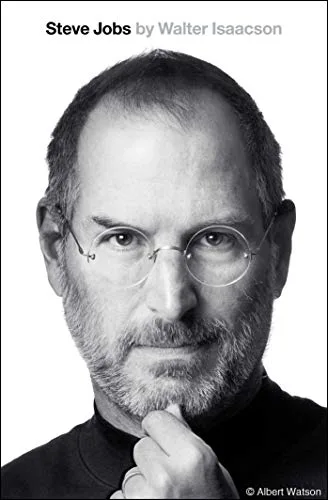
Steve Jobs
- Published
- 2011
- Pages
- 656 pages
- Publisher
- Simon & Schuster
- Readers
- 1 member has read this
The authorized biography of Apple's co-founder, built from more than 40 interviews with Jobs and over 100 with family, colleagues and rivals. Walter Isaacson shows how one difficult, obsessive founder was pushed out of his own company, rebuilt himself through NeXT and Pixar, and returned to turn a near-bankrupt Apple into the most valuable business of its era.
Jobs asked Walter Isaacson to write his life story, gave him more than 40 interviews over two years and then, by Isaacson's account, asked for no control over the text beyond the cover. Isaacson also interviewed more than a hundred friends, family members, colleagues, competitors and adversaries. The book was published 19 days after Jobs died in October 2011.
Isaacson, a former managing editor of Time and chairman of CNN who went on to run the Aspen Institute, had already written biographies of Benjamin Franklin, Albert Einstein and Henry Kissinger. His portrait is candid: Publishers Weekly and Kirkus both noted how fully it records Jobs's egotism, his habit of claiming others' ideas, his humiliation of staff and the reality distortion field he used to bend facts. Publishers Weekly thought it overplayed the contrast between Jobs the digital artist and Bill Gates the software licenser, and Kirkus wanted a tighter edit.
Some who knew Jobs best, including Tim Cook, Jony Ive and Laurene Powell Jobs, publicly disapproved of its portrait; Brent Schlender and Rick Tetzeli's Becoming Steve Jobs is the usual counterweight. The book sold more than three million US copies and was shortlisted for the FT and Goldman Sachs Business Book of the Year.
For finance readers it is less a business manual than a case study in product focus, founder risk and how a company near collapse was rebuilt.
- Focus is a strategy. On his return Jobs cut Apple's sprawling product line down to a handful of machines, a lesson in how a turnaround starts with saying no.
- Control of the whole product is a choice with trade-offs. Jobs's insistence on integrating hardware, software and content produced great products, and the book shows the costs of that closed approach as well as its rewards.
- Founder risk cuts both ways. The same intensity that built Apple led to his 1985 ouster, so investors should weigh how much of a company's value rests on one person.
- Failure can be an incubator. NeXT's operating system became the base of Apple's comeback, and Pixar made Jobs rich before Apple did.
- Culture and temperament are hard to separate. Jobs's demands drove people to exceptional work and also drove some away, a tension any investor in founder-led companies has to price.
The book runs chronologically across 42 chapters, from Jobs's birth in 1955 to his final months.
- Origins. His adoption, his upbringing in what became Silicon Valley, Reed College, his travels in India and his partnership with Steve Wozniak, which produced the Apple I and Apple II.
- The Macintosh and the fall. Jobs drives the Mac team, recruits John Sculley from Pepsi and then loses a boardroom fight that pushes him out of Apple in 1985.
- The wilderness years. He founds NeXT, which struggles commercially, and buys the computer graphics group that becomes Pixar, whose success with Toy Story and its stock market debut restore his fortune and standing.
- The return. Apple buys NeXT, Jobs takes control, cuts the product line, makes peace with Microsoft and launches the iMac.
- The digital hub. The iPod and iTunes store, Apple's retail stores, the iPhone and the iPad turn Apple into the world's most valuable technology company, while Jobs fights pancreatic cancer and prepares Tim Cook to succeed him.
Based on more than 40 interviews with Jobs conducted over two years - as well as interviews with more than a hundred family members, friends, adversaries, competitors, and colleagues - Walter Isaacson has written a riveting story of the roller-coaster life and searingly intense personality of a creative entrepreneur whose passion for perfection and ferocious drive revolutionized six industries: personal computers, animated movies, music, phones, tablet computing, and digital publishing.
At a time when America is seeking ways to sustain its innovative edge, and when societies around the world are trying to build digital-age economies, Jobs stands as the ultimate icon of inventiveness and applied imagination. He knew that the best way to create value in the 21st century was to connect creativity with technology. He built a company where leaps of the imagination were combined with remarkable feats of engineering.
Although Jobs cooperated with this book, he asked for no control over what was written. He put nothing off-limits. He encouraged the people he knew to speak honestly. And Jobs speaks candidly, sometimes brutally so, about the people he worked with and competed against. His friends, foes, and colleagues provide an unvarnished view of the passions, perfectionism, obsessions, artistry, devilry, and compulsion for control that shaped his approach to business and the innovative products that resulted.
Driven by demons, Jobs could drive those around him to fury and despair. But his personality and products were interrelated, just as Apple's hardware and software tended to be, as if part of an integrated system. His tale is instructive and cautionary, filled with lessons about innovation, character, leadership, and values.
Reader reviews
No reviews yet. Join to write the first one.