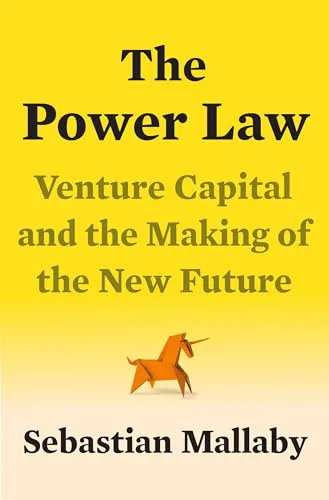
The Power Law
Venture Capital and the Making of the New Future
- Published
- 2022
- Pages
- 496 pages
- Publisher
- Penguin Press
- Readers
- 0 members have read this
A history of venture capital from Arthur Rock and Fairchild Semiconductor to Sequoia, Kleiner Perkins, Accel, SoftBank and the unicorn era, built on interviews with the investors themselves. It explains the logic of the business: most bets fail, a few return the fund many times over, and that skewed math shapes how VCs pick, back and fight with founders.
Sebastian Mallaby's subject is the investment style behind Silicon Valley. Venture capitalists, he argues, do not try to avoid losses. They accept that most of their bets will go to zero, because returns follow a power law in which one Google, Facebook or Cisco can repay an entire fund. That logic explains why VCs chase radical ideas, why they cluster in networks and why a firm's reputation compounds over decades.
Mallaby spent thirteen years at The Economist and later wrote for the Washington Post and the FT. He is now a senior fellow at the Council on Foreign Relations. His earlier books include More Money Than God, a history of hedge funds, and The Man Who Knew, a biography of Alan Greenspan that won the FT Business Book of the Year. For this book he drew on extensive interviews with venture investors and the founders they backed.
The narrative covers seven decades of the industry, including its poor record on backing women and minorities. Publishers Weekly called it lucid and entertaining. The New York Times review by Jennifer Szalai described it as friendly to the funders, and readers looking for a critique of venture capital's social effects will find a sympathetic account instead.
The book was shortlisted for the 2022 FT Business Book of the Year. It is the best overall history of the industry for anyone considering a career in venture or growth investing, or anyone allocating to it.
- Returns follow a power law. A few outlier investments drive nearly all of a fund's gains, so the cost of missing a winner far exceeds the cost of backing a failure.
- Venture capital is active, not passive. From Kleiner Perkins at Genentech to Sequoia at Cisco, the best VCs recruit executives, coach founders and sometimes replace them.
- Networks and reputation compound. Firms that win early access to top founders keep getting it, which helps explain the persistence of returns among top-quartile managers.
- Founder-friendly money has a cost. The cases of Uber and WeWork show how weak governance and huge growth rounds can let a founder's excesses go unchecked.
- Luck matters, but skill shows. Mallaby argues that consistent success at firms such as Sequoia reflects real judgment, which matters for anyone choosing which venture funds to back.
Mallaby tells the story chronologically, using a handful of investors and deals to stand for each era.
- Origins. Arthur Rock helps the engineers who left Shockley Semiconductor found Fairchild in 1957, then helps pioneer the limited-partnership fund, with equity for founders and employees. Venture capital emerges as a distinct kind of finance.
- The first great firms. Don Valentine's Sequoia and Tom Perkins's Kleiner Perkins make venture capital hands-on, backing companies such as Atari, Apple, Genentech and Cisco and shaping their management.
- The internet boom. Benchmark, Kleiner Perkins and others fund the web's first giants, Google among them, while SoftBank's Masayoshi Son shows how much capital can distort the game.
- A youth revolt. Peter Thiel, Paul Graham's Y Combinator and Accel's investment in Facebook shift power toward young founders, and growth investors such as Yuri Milner's DST write large checks without board seats.
- Going global. Venture investing takes root in China, where firms that copied the Silicon Valley model help build the country's internet champions.
- The unicorn era. Cheap money and founder-friendly terms produce Uber's governance fight and the WeWork debacle. Mallaby closes by weighing luck against skill and arguing that venture capital is a national asset worth cultivating.
Innovations rarely come from “experts.” Elon Musk was not an “electric car person” before he started Tesla. When it comes to improbable innovations, a legendary tech VC told Sebastian Mallaby, the future cannot be predicted, it can only be discovered. It is the nature of the venture-capital game that most attempts at discovery fail, but a very few succeed at such a scale that they more than make up for everything else. That extreme ratio of success and failure is the power law that drives the VC business, all of Silicon Valley, the wider tech sector, and, by extension, the world.
In The Power Law, Sebastian Mallaby has parlayed unprecedented access to the most celebrated venture capitalists of all time—the key figures at Sequoia, Kleiner Perkins, Accel, Benchmark, and Andreessen Horowitz, as well as Chinese partnerships such as Qiming and Capital Today—into a riveting blend of storytelling and analysis that unfurls the history of tech incubation, in the Valley and ultimately worldwide. We learn the unvarnished truth, often for the first time, about some of the most iconic triumphs and infamous disasters in Valley history, from the comedy of errors at the birth of Apple to the avalanche of venture money that fostered hubris at WeWork and Uber.
VCs’ relentless search for grand slams brews an obsession with the ideal of the lone entrepreneur-genius, and companies seen as potential “unicorns” are given intoxicating amounts of power, with sometimes disastrous results. On a more systemic level, the need to make outsized bets on unproven talent reinforces bias, with women and minorities still represented at woefully low levels. This does not just have social justice implications: as Mallaby relates, China’s homegrown VC sector, having learned at the Valley’s feet, is exploding and now has more women VC luminaries than America has ever had. Still, Silicon Valley VC remains the top incubator of business innovation anywhere—it is not where ideas come from so much as where they go to become the products and companies that create the future. By taking us so deeply into the VCs’ game, The Power Law helps us think about our own future through their eyes.
Reader reviews
No reviews yet. Join to write the first one.