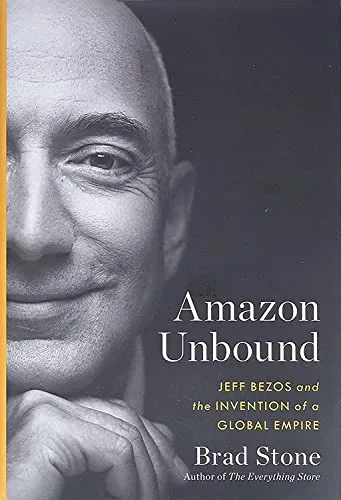
Amazon Unbound
Jeff Bezos and the Invention of a Global Empire
by Brad Stone
- Published
- 2021
- Pages
- 496 pages
- Publisher
- Simon & Schuster
- Readers
- 2 members have read this
Brad Stone's sequel to The Everything Store covers Amazon's decade from 2010 to the pandemic: Alexa, the Fire phone, AWS, the third-party marketplace, the last-mile delivery network, advertising, Whole Foods, HQ2 and the antitrust backlash. For investors it is the most detailed reported account of how Bezos built the company's operating leverage.
In the decade before Jeff Bezos handed the CEO job to Andy Jassy in 2021, Amazon went from mainly an online retailer with a young cloud business to a company worth more than $1.5 trillion. Brad Stone explains how: by inventing new businesses such as Alexa and Prime Video, and by squeezing more profit from old ones through third-party sellers, its own delivery network and ads in its search results. He also follows Bezos's change from a nerdy founder into a celebrity billionaire.
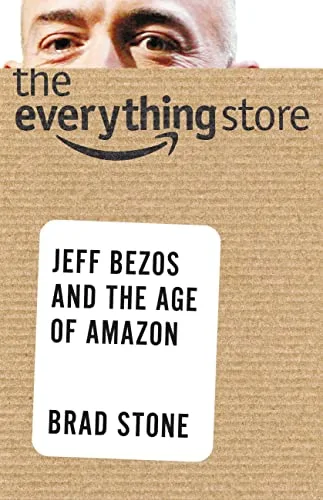
Stone is a senior executive editor at Bloomberg News and the author of The Everything Store and The Upstarts. He built the book on interviews with current and former Amazon executives. Aaron Pressman, reviewing it for Fortune, called him intrepid and well sourced and pointed to scoops such as the discarded names for Alexa and the debate inside AWS over whether cloud could ever be a billion-dollar business.
The same reviewer said the book will not change many readers' views of Amazon or its market power. Some readers felt it spent too long on side projects and Bezos's personal life and moved quickly past the company's failures.
Read it for the business mechanics. The chapters on the marketplace, logistics and advertising explain the flywheel and the margins behind Amazon's earnings, and the later chapters cover the regulatory risk now hanging over the stock.
- Operating leverage is the strategy. Bezos favored businesses where revenue could grow faster than costs and headcount, such as marketplace fees, fulfillment services and advertising.
- Advertising saved the retail margin. Sponsored listings grew into a high-margin business that hid slowing growth in Amazon's own retail sales.
- Vertical integration of logistics is a moat. By building its own last-mile delivery and air freight network, Amazon cut its reliance on UPS and FedEx and gained control over speed and cost.
- Big bets need patience and tolerance for failure. The Fire phone flopped while Alexa and AWS succeeded, and Bezos's habit of funding many experiments explains both outcomes.
- Scale invites political risk. HQ2, labor criticism and antitrust scrutiny show that public goodwill becomes a constraint for a dominant platform.
The book is organized in three parts that follow Amazon's arc from experiment to dominance, followed by its reckoning with regulators and the public.
- Invention. Bezos as what staff called an uber product manager, closely involved in Alexa and the Echo, the early growth of Amazon Web Services, the costly push into India, the failed Fire phone, Bezos's purchase of the Washington Post, and Amazon Studios' effort to make data-driven television.
- Leverage. How Amazon squeezed operating leverage from retail. The third-party marketplace became a selection machine, Dave Clark's teams built a delivery network to control the last mile, and sponsored-product ads became a gold mine. The part closes with Bezos's rocket company, Blue Origin.
- Invincibility. The HQ2 contest and the backlash that sank the New York plan, Bezos's divorce and his clash with the National Enquirer, the antitrust investigations by Congress and regulators, and the Covid-19 pandemic, which turned Amazon into essential infrastructure. The book ends as Bezos hands the company to Andy Jassy.
From the bestselling author of The Everything Store, an unvarnished picture of Amazon’s unprecedented growth and its billionaire founder, Jeff Bezos, revealing the most important business story of our time. With the publication of The Everything Store in 2013, Bloomberg journalist Brad Stone revealed how the unlikely Seattle start-up Amazon became an unexpected king of ecommerce. Since then, its founder has led Amazon to explosive growth in both size and wealth. In less than ten years, Amazon has quintupled the size of its workforce and increased its valuation to well over a trillion dollars. Whereas Amazon used to sell only books, there is now little they don’t sell, becoming the world’s largest online retailer and pushing into other markets at warp speed. Between Amazon’s forty subsidiaries - like Whole Foods Market, Amazon Studios in Hollywood, websites like Goodreads and IMDb, and Amazon Web Services cloud software unit, plus Bezos’s purchase of the Washington Post - it’s almost impossible to go a day without encountering their goods. Amazon provides us opportunities to shop, entertain, inform, communicate, store and, one day, maybe even travel to the moon. We live in a world run, supplied and controlled by Amazon. In Amazon Unbound, Stone offers the must-read follow-up to his bestseller The Everything Store, detailing the seismic changes that have taken place at Amazon over the past decade as it became one of the most powerful and feared companies in the global economy, led by one of the most powerful and feared leaders in business. He shows the acquisitions and innovations that have propelled Amazon’s unprecedented growth, and the turn in public sentiment that criticises Amazon’s monopolistic practices. As he charts the company’s meteoric rise, Stone probes the evolution of Jeff Bezos - who started as a geeky entrepreneur but who transformed to become a fit, famed, disciplined billionaire, a man who runs Amazon with an iron fist but finds his personal life splashed over the tabloids. Definitive, timely and revelatory, Stone has provided an unvarnished portrait of a man and company that we couldn’t imagine modern life without.
Reader reviews
No reviews yet. Join to write the first one.