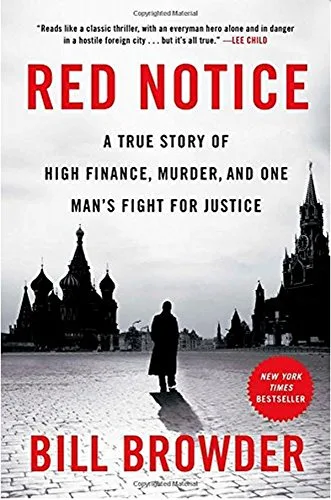
Red Notice
A True Story of High Finance, Murder, and One Man's Fight for Justice
by Bill Browder
- Published
- 2015
- Pages
- 396 pages
- Publisher
- Simon & Schuster
- Readers
- 3 members have read this
Bill Browder built Hermitage Capital into one of the largest foreign investors in Russia by buying cheap privatized shares and fighting corrupt managers, until the Kremlin expelled him, seized his companies and imprisoned his lawyer Sergei Magnitsky, who died in custody. Part investing memoir, part thriller, it is a sharp lesson in emerging-market and political risk.
Browder, the grandson of Communist Party USA leader Earl Browder, went from a Stanford MBA to Boston Consulting Group, Robert Maxwell's company and the Russian proprietary desk at Salomon Brothers before co-founding Hermitage Capital Management in 1996 with the banker Edmond Safra. By 2005 the fund managed more than $4 billion, and Browder had become an activist shareholder who publicized theft at Gazprom and other Russian companies to protect his investments.
The book is his account of that run and of what followed: Russia barring him as a threat to national security, the seizure of Hermitage's Russian companies to claim a $230 million tax refund, and the death in prison of Magnitsky, the tax lawyer who uncovered the fraud, which led to Browder's campaign for the U.S. Magnitsky Act.
Kirkus called it well paced and heartfelt, and Publishers Weekly praised its detailed picture of Russia's kleptocratic economy. It is Browder's account, and Russia's government, a 2016 film by Andrei Nekrasov and a 2019 Der Spiegel investigation have all disputed parts of his version of the Magnitsky case.
Read it for a first-hand account of what investing in a market without rule of law actually involves.
- Cheap can stay cheap without property rights. Russian assets traded at huge discounts because the legal system could not protect minority shareholders, and that risk was real.
- Activism works only where the state allows it. Browder's campaigns succeeded while they suited the Kremlin and ended when they did not.
- Political risk can take everything. A fund can be right about valuation and still lose its business, its staff's safety and its assets to the state.
- Legal machinery can be turned on you. The $230 million fraud worked by taking control of Hermitage's Russian companies and using them to claim a tax refund, showing how courts, police and registries can be used against investors.
- Sanctions can target individuals. The Magnitsky Act created a model for freezing the assets of named officials, which now features in compliance work at banks and funds.
The book follows Browder's life from investor to human rights campaigner.
- Rebelling into capitalism. Despite a family of communists and mathematicians, Browder chooses capitalism, earns his Stanford MBA and works at BCG, Robert Maxwell's company and Salomon Brothers, where he invests in newly privatized Eastern European and Russian companies.
- Hermitage and the Russian boom. With Edmond Safra's backing he launches Hermitage in 1996 and buys deeply discounted Russian shares, and by 2000 runs one of the best-performing emerging-markets funds and the largest investor in the Russian stock market.
- Fighting the oligarchs. Browder uses research, the press and shareholder rights to expose asset stripping at Gazprom and other companies, at first with Putin's apparent approval.
- Expulsion and theft. He is barred from Russia in 2005, Hermitage's offices are raided, and officials use its seized companies to steal $230 million in taxes.
- Magnitsky. His lawyer Sergei Magnitsky testifies about the fraud, is arrested, denied medical care and dies in prison in 2009.
- The campaign. Browder lobbies in Washington and Europe for sanctions, leading to the 2012 Magnitsky Act, while Russia tries Browder in absentia.
New York Times bestseller THE BOOK THAT EXPLAINS WHY RUSSIANS WANTED TO MEET WITH THE TRUMP CAMPAIGN Part John Grisham-like thriller, part business and political memoir.” —The New York Times [Red Notice] does for investing in Russia and the former Soviet Union what Liar’s Poker did for our understanding of Salomon Brothers, Wall Street, and the mortgage-backed securities business in the 1980s. Browder’s business saga meshes well with the story of corruption and murder in Vladimir Putin’s Russia, making Red Notice an early candidate for any list of the year’s best books” (Fortune). This is a story about an accidental activist. Bill Browder started out his adult life as the Wall Street maverick whose instincts led him to Russia just after the breakup of the Soviet Union, where he made his fortune. Along the way he exposed corruption, and when he did, he barely escaped with his life. His Russian lawyer Sergei Magnitsky wasn’t so lucky: he ended up in jail, where he was tortured to death. That changed Browder forever. He saw the murderous heart of the Putin regime and has spent the last half decade on a campaign to expose it. Because of that, he became Putin’s number one enemy, especially after Browder succeeded in having a law passed in the United States—The Magnitsky Act—that punishes a list of Russians implicated in the lawyer’s murder. Putin famously retaliated with a law that bans Americans from adopting Russian orphans. A financial caper, a crime thriller, and a political crusade, Red Notice is the story of one man taking on overpowering odds to change the world, and also the story of how, without intending to, he found meaning in his life.
Reader reviews
No reviews yet. Join to write the first one.