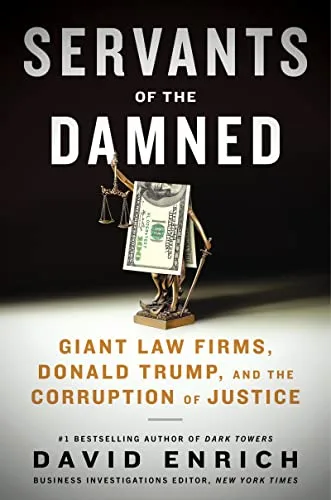
Servants of the Damned
Giant Law Firms, Donald Trump, and the Corruption of Justice
by David Enrich
- Published
- 2022
- Pages
- 384 pages
- Publisher
- Mariner Books
- Readers
- 2 members have read this
The New York Times business investigations editor turns from banks to Big Law, using Jones Day as his case study. He follows the firm's growth from a Cleveland practice into a political and corporate powerhouse that defended tobacco and drug companies, staffed the Trump White House and worked on 2020 election litigation. It shows what top law firms will do, and for whom, when the fees are large enough.
David Enrich's argument is that the biggest American law firms have become businesses first and professions second, willing to serve almost any client who can pay. Jones Day is his central example, from its fights against the Affordable Care Act and voting-rights laws to its work for Donald Trump's campaigns. He traces how law firm advertising and profit rankings from the 1970s onward pushed firms toward aggressive revenue growth, and how that shows up in individual cases for clients such as R.J. Reynolds, Purdue Pharma and Russian oligarchs.
Enrich wrote Dark Towers, about Deutsche Bank, and The Spider Network, about the Libor scandal, so he knows how to follow money through large institutions.
Kirkus gave it a starred review and called it fast-moving and damning. Publishers Weekly called it vivid and crackling, but noted that his condemnations are not always airtight: he brushes aside testing that found no contamination in Abbott's Similac infant formula, which a family said gave their newborn meningitis. The book is plainly a prosecutor's brief.
Finance readers who hire, pay or rely on outside counsel, and anyone curious how a partnership's economics shape its ethics, will find it useful.
- Big Law is a business. Profit-per-partner rankings and growth targets drive which clients firms take and how hard they fight. Read their incentives the way you would read a company's.
- Reputation risk is shared. Companies that hire aggressive firms inherit their tactics. A litigation strategy that wins in court can still damage a brand.
- The revolving door runs through law firms. Lawyers who move between firms and government carry relationships both ways, which matters to anyone exposed to regulatory decisions.
- Follow the fees. Enrich applies the method he used on Deutsche Bank and Libor: track who pays whom, and the institution's behavior starts to make sense.
- Read advocacy as advocacy. Even sympathetic reviewers noted that Enrich sometimes overreaches. The book is most useful when its case studies are weighed against the evidence on the other side.
The book weaves the institutional history of Jones Day with detailed case narratives.
- From Cleveland to Washington. Enrich traces the firm's 19th-century roots, its growth into a global partnership and its rightward turn under Steve Brogan, with lawyers moving between the firm, Republican administrations and conservative legal causes.
- Law becomes a business. He explains how advertising, published profit rankings and the race for revenue changed big firms from the 1970s on, and why that rewarded taking any lucrative client.
- The cases. Enrich follows Jones Day's work for tobacco maker R.J. Reynolds, its defense of Abbott Laboratories in the Similac meningitis case, and its work for Purdue Pharma, the Catholic Church in its abuse scandals, Fox News against harassment claims from employees, and Russian oligarchs.
- The Trump years. Don McGahn and his mentor Ben Ginsberg take on the 2016 Trump campaign, expecting it to lose and to live on as a fundraising operation the firm would represent. McGahn becomes White House counsel, Jones Day lawyers fill administration jobs and handle judicial nominations, and the firm helps Trump fend off the Mueller investigation.
- 2020 and after. The firm lays some of the legal groundwork for challenging the 2020 result and takes on election litigation in Pennsylvania amid internal dissent, and Enrich considers what its choices say about the legal profession.
The NYT's Business Investigations Editor reveals the dark side of American law. Delivering a devastating and rollicking (Carol Leonnig) exposé of the astonishing power wielded by the world’s largest law firms, David Enrich traces how one firm shielded OPIOID MAKERS, GUN COMPANIES, BIG TOBACCO, THE CATHOLIC CHURCH, RUSSIAN OLIGARCHS, FOX NEWS, and much of the FORTUNE 500; helped DONALD TRUMP get elected, govern, and evade investigation; masterminded the conservative remaking of THE COURTS . . . AND MADE A KILLING ALONG THE WAY In his acclaimed #1 bestseller Dark Towers, David Enrich presented the never-before-told saga of how Deutsche Bank became the global face of financial recklessness and criminality. Now Enrich turns his eye towards the world of Big Law” and the nearly unchecked influence these firms wield to shield the wealthy and powerful—and bury their secrets. To tell this story, Enrich focuses on Jones Day, one of the world’s largest law firms. Jones Day’s narrative arc—founded in Cleveland in 1893, it became the first law firm to expand nationally and is now a global juggernaut with deep ties to corporate interests and conservative politics—is a powerful encapsulation of the changes that have swept the legal industry in recent decades. Since 2016, Jones Day has been in the spotlight for representing Donald Trump and his campaigns (and now his PACs)—and for the fleet of Jones Day attorneys who joined his administration, including White House Counsel Don McGahn. Jones Day helped Trump fend off the Mueller investigation and challenged Obamacare. Its once and future lawyers defended Trump’s Muslim ban and border policies and handled his judicial nominations. Jones Day even laid some of the legal groundwork for Trump to challenge the legitimacy of the 2020 election. But the Trump work is but one chapter in the firm’s checkered history. Jones Day, like many of its peers, have become highly effective enablers of the business world’s worst misbehavior. The firm has for decades represented Big Tobacco in its fight to avoid liability for its products. Jones Day worked tirelessly for the Catholic Church as it tried to minimize its sexual-abuse scandals. And for Purdue Pharma, the maker of OxyContin, as it sought to protect its right to make and market its dangerously addictive drug. And for Fox News as it waged war against employees who were the victims of sexual harassment and retaliation. And for Russian oligarchs as their companies sought to expand internationally. In this gripping and revealing new work of narrative nonfiction, Enrich makes the compelling central argument that law firms like Jones Day play a crucial yet largely hidden role in enabling and protecting powerful bad actors in our society, housing their darkest secrets, and earning billions in revenue for themselves.
Reader reviews
No reviews yet. Join to write the first one.